
Reviewed · CYCLING TOURS
Discover Kyoto by Bike Full Day Tour
Kyoto on wheels is the easy way. I like the relaxed pace with built-in photo stops, and I love that this ride uses backstreets so you spend less time grinding through bus crowds. You get a local guide, and that matters because the day connects big-name sights like Toji and Ginkakuji with quieter corners such as Honen-in and Miyagawacho.
One thing to plan for: moderate fitness is required, including riding about 32 kilometers and maneuvering on narrow paths. Lunch is not listed as included, so build in your own fuel stop or snacks.
In This Review
- Key highlights
- Getting Your Bearings Fast, One Bike Ride at a Time
- Meeting Point and Timing: Plan Your Morning Around 9:00 am
- The Physical Side of Kyoto by Bike: 32 km and Narrow Paths
- Toji Starts the Day Strong: UNESCO Pagoda and an Easy Stroll
- Umekoji Park and Ryukoku University: The “Local Life” Interlude
- Nishi Honganji and the Courtyard Moment
- Along the Kamo River and Toward Miyagawacho
- Heian Shrine and the Vermilion Gate Reality Check
- Lake Biwa Canal Museum: Engineering That Changed Daily Life
- Nanzen-ji: Zen Gardens and the Red Brick Aqueduct
- Philosopher’s Path: A Quiet Walk Along a Canal Line
- Honen-in: Small Temple Calm in the Hills
- Ginkakuji, the Silver Pavilion: Called Silver, Not Silver
- Gion at Bike Speed: Machiya Lanes and Lantern Light
- Price and Value: What You Pay For at $128.48
- Who This Tour Fits Best (and Who Should Skip)
- Should You Book This Kyoto Bike Day?
- FAQ
- How long is the Kyoto by Bike full-day tour?
- What time does the tour start, and where is the meeting point?
- Are e-bikes included?
- What fitness level do I need?
- Is lunch included?
- Are admission tickets included?
- Is this a private tour?
- Will I receive a mobile ticket?
- What happens if the weather is bad?
- What is the cancellation policy?
Key highlights
- Small-group, private experience so you can move at a comfortable speed and ask questions
- E-bike support for a long day (about 32 km) without turning it into a fitness test
- UNESCO-focused routing with Toji and major temples, plus lesser-known temple time in Honen-in
- Riverside and canal scenery on the Kamo River and Philosopher’s Path, often calmer than the main streets
- Geisha-district contrast with both Miyagawacho and classic Gion lantern lanes
- Guide Jaime’s friendly, practical explanations that help you understand what you’re looking at
Getting Your Bearings Fast, One Bike Ride at a Time
If you only have a day and you want Kyoto to feel like Kyoto, a bike tour like this one is a smart match. You start in southern Kyoto and move north in a way that makes sense geographically, not just chronologically. That means less zigzagging, fewer wasted minutes, and more time at the places that actually reward slow looking.
The route also gives you variety without making you sprint between stops. You’ll do short temple visits, then ride segments that let your eyes adjust: parks and open green space early on, then river paths, then shrine and temple areas, and finally the lanes around Gion. One strong theme in the day is balance, some top-name landmarks, plus smaller stops that usually take more time to find on your own.
And yes, you will hit areas that feel busy. Still, the ride helps. The in-between cycling is where this tour earns its value, since it can keep you out of some of the densest pedestrian bottlenecks.
Meeting Point and Timing: Plan Your Morning Around 9:00 am
The tour meets at a 7-Eleven at 44-1 Higashikujō Kamitonodachō, Minami Ward, Kyoto with a 9:00 am start. It ends back at the same meeting point, so you can build your day around an easy return.
Because it’s a full-day schedule (about 7 to 8 hours), I suggest you treat the morning like the start of an all-weather plan. Wear clothes you can move in, not just sightsee in. Even with e-bike help, you’ll be on the saddle for long stretches.
Also note the practical side: the meeting point is said to be near public transportation, so you should be able to get there without a complicated transit puzzle. And you’ll use a mobile ticket, which keeps things simple when you’re bouncing between neighborhoods.
A quieter way to spend a day in Kyoto
- Hidden Kyoto E-Biking tour
★ 5.0 · 1,843 reviews - Bike Tour Exploring North Kyoto plus Lunch
★ 5.0 · 1,087 reviews - Arashiyama Bamboo Forest & Hidden Gems Bike Tour (Early Bird)
★ 5.0 · 613 reviews - 5 Top Highlights of Kyoto Full Day Bike Tour (E-bike option)
★ 5.0 · 511 reviews
The Physical Side of Kyoto by Bike: 32 km and Narrow Paths
This is the part you should respect. The tour asks for moderate physical fitness and says you need to be fit enough to ride about 32 kilometers and maneuver safely on narrow paths. Translation: it is not just a casual cruise.
The good news is that the bike is an e-bike. That’s not magic, but it helps you keep a steady rhythm instead of burning yourself out early. The other good news is that the stops are timed and the pace is described as relaxed, so you’re not expected to stand around forever or race the clock.
My practical advice:
- If you’ve never ridden an e-bike before, practice a few minutes with the assist settings before you join the main ride.
- If you’re sensitive to tight traffic flow, focus on smooth control and slower turning at narrow corners.
- Bring layers. Kyoto mornings can start cool, then warm up, especially when you’re cycling.
Toji Starts the Day Strong: UNESCO Pagoda and an Easy Stroll
The day begins at Toji, a UNESCO World Heritage Site known for its five-story pagoda, described as the tallest wooden tower in Japan. This is a great warm-up stop because it’s walkable even if you’re still getting used to the morning pace.
What I like about starting here is the shift in mood. You go from city movement into temple grounds where you can slow your breathing and reset your eyes. You also get a landmark that immediately anchors the day. Later, you’ll see more temples and gardens, but Toji gives you a first big reference point.
The tour time at Toji is about 15 minutes, so you’ll likely do a peaceful stroll rather than a marathon sightseeing session. That works well for first-timers who want meaningful highlights without feeling rushed.
Umekoji Park and Ryukoku University: The “Local Life” Interlude
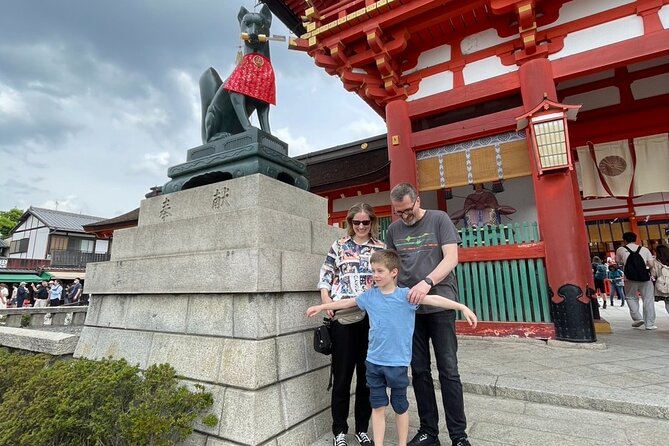
After Toji, you move into Umekoji Park, where the atmosphere shifts quickly. This is the kind of place that feels like a breather, with seasonal flowers, shady trees, and a serene pond where you can pause.
Then comes a stop that many visitors skip: the Ryukoku University Omiya Campus. This is one of Kyoto’s older private universities, founded by the Nishi Hongwanji sect of Buddhism. You’re not there for a campus tour. You’re there to glimpse how modern Kyoto lives alongside religious tradition.
This interlude is valuable because it breaks the temple-heavy rhythm. It also makes the day feel more real, not just a checklist of famous monuments.
Nishi Honganji and the Courtyard Moment
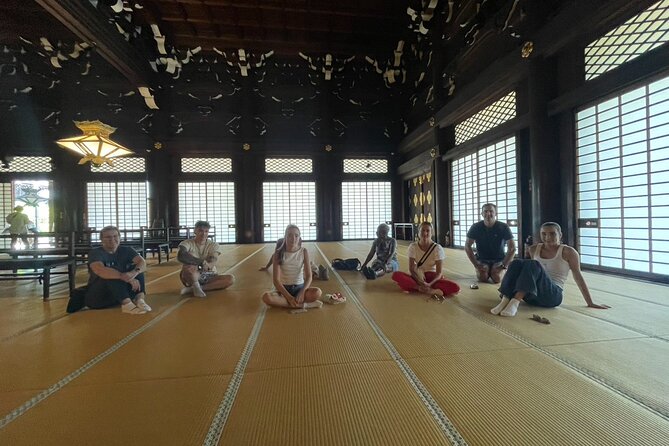
Next up is Nishi Honganji, a major Jodo Shinshu Buddhist temple and a UNESCO site. It’s known for its wooden architecture and historical role, and the tour gives you time to walk the vast courtyard and hear what it means in practice.
The time here is about 30 minutes, which is enough to notice details without feeling like you need to read every sign and translation. If you usually fly through temples, this stop can teach you a better pace: look at structure first, then absorb the atmosphere.
Also, this is one of those places where photos can be tricky. Wide views help, but so do slow angles that show the scale of the buildings. Even a short visit can feel rewarding if you take it one corner at a time.
A day of temples goes further with something to break it up.
Along the Kamo River and Toward Miyagawacho
After temple time, you switch to riding. The route includes cycling along the Kamo River, described as a favorite spot for locals to relax, jog, and enjoy nature. This matters because it gives you an easy scenic ride segment, not a stressful transfer.
Then you head toward a geisha district near Gion, identified here as Miyagawacho. This is a quieter cousin to the main lanes, and the tour approach is a “quiet ride through beautiful alleys.” That wording is doing real work. You’re not just looking at a district from a crowded sidewalk. You’re moving through it, which changes what you notice.
Between Kyoto’s busiest pockets and its calmer streets, that contrast is the point. If you want the feel of older Kyoto without getting stuck in the thickest crowds for every minute, this is the portion that tends to make the whole day click.
Heian Shrine and the Vermilion Gate Reality Check
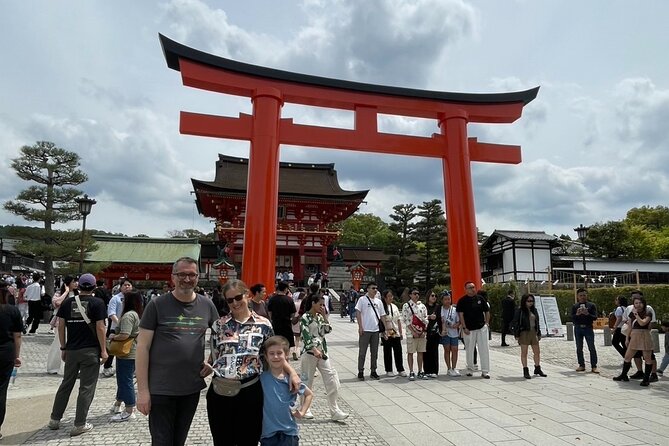
The ride continues to Heian Shrine, built in 1895 to mark Kyoto’s 1,100th anniversary. You’ll see the bright vermilion gate, and the buildings are modeled after the ancient Imperial Palace. Nearby, the tour also mentions seeing one of Japan’s largest torii.
This stop is only about 10 minutes, so it helps to know what you’re aiming to see. Heian Shrine is one of those classic “big composition” places. If you spend your time trying to memorize every detail, you’ll feel like the visit ends too soon. If you instead focus on the gate, the axis of the grounds, and the scale, you get the full value of the short time.
This is also a useful stop for structure and orientation. You’re moving toward the north side of the city, and Heian Shrine’s palace-like layout gives you a visual framework for what you’ll see next.
Lake Biwa Canal Museum: Engineering That Changed Daily Life
Then you shift from postcard scenery to something more unusual for a bike tour: the story of the Lake Biwa Canal at the Biwa Aqueduct Museum. The tour frames it as an engineering project from the 1890s that brought water and electricity, helping reshape life in Kyoto.
This stop is about 10 minutes, so it’s not going to turn into a museum day. Still, it gives you context that makes Kyoto feel less like a set of temples and more like a living city that had to solve real problems. You leave with a clearer sense that Kyoto’s beauty and preservation also depends on infrastructure.
If you tend to skip informational stops, try not to here. This is the kind of short stop that can quietly upgrade how you understand a place.
Nanzen-ji: Zen Gardens and the Red Brick Aqueduct
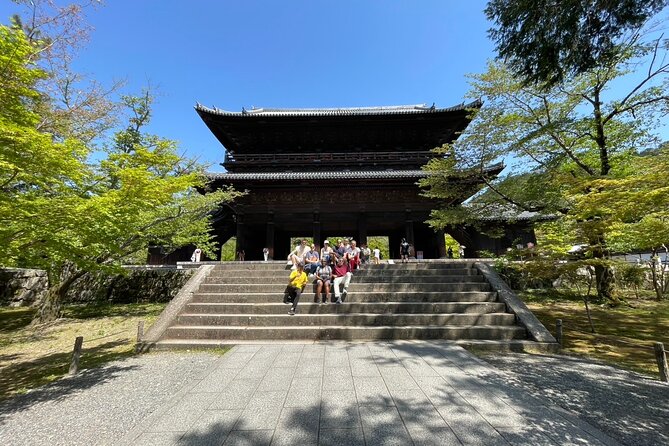
Next is Nanzen-ji, one of Kyoto’s important Zen temples founded in the 13th century. The tour highlights three big features: the massive wooden Sanmon gate, peaceful Zen gardens, and a red brick aqueduct that runs through temple grounds.
You get about 25 minutes here, which is enough for a layered look. Nanzen-ji can feel dramatic, even if you’re not into Zen. The aqueduct in particular adds a different kind of visual rhythm. It also makes the temple space feel more connected to the city’s broader life.
This is a stop where photos can be great, but walking a few steps off your first camera angle helps. The gate scale looks different up close versus across the grounds.
Philosopher’s Path: A Quiet Walk Along a Canal Line
After Nanzen-ji, you reach the Philosopher’s Path, a stone walkway that follows a canal lined with cherry trees. It’s named after Kyoto University professor Nishida Kitaro, who used to walk here while meditating on his ideas.
Even if you’re not traveling in peak cherry season, the canal setting is the point. This is where the day slows a bit in feel. The tour time for this segment is described as a stop, and the framing suggests short walking and photo time.
Practical tip: if you come when it’s cold, expect some slick surfaces near shaded areas. If you come in warm months, expect people. Either way, don’t treat this as a long hike. It’s a gentle stroll and a chance to let the city noise fade.
Honen-in: Small Temple Calm in the Hills
Then comes Honen-in, described as a quiet temple tucked into the hills and founded in the 1600s to honor priest Honen, who spread Pure Land teachings. The tour points out a mossy gate and white sand patterns.
This stop is about 20 minutes, which is a sweet spot. Honen-in feels like the kind of place where you should sit with it for a moment. You’re not going to get that “I saw everything” feeling here, and that’s okay. Instead, you get the relief of a calmer pocket in a city that can feel intense.
If you love gardens, sand patterns, or just the way light changes inside temple compounds, Honen-in is one of the better payoff stops on the day.
Ginkakuji, the Silver Pavilion: Called Silver, Not Silver
Finally, you reach Ginkakuji, the Silver Pavilion. It was built in the late 1400s by shogun Ashikaga Yoshimasa. The key detail the tour emphasizes is that despite the name, it was never actually covered in silver.
You get around 25 minutes here, and this is the one temple admission listed as included. That helps justify the cost, since most other listed admissions are marked free.
What to expect: the pavilion is the centerpiece, but the setting matters too. This is another “composition” stop. Don’t just snap a picture and move on. Walk enough to see how the perspective changes as you approach and then step back.
If you want the day to feel special at the end, this is where it happens.
Gion at Bike Speed: Machiya Lanes and Lantern Light
The day wraps with Gion, Kyoto’s famous geisha district. The tour focuses on traditional machiya houses, then explains the culture of geiko and maiko while you ride through the lantern-lit lanes.
The time here is about 15 minutes, so you’ll feel it as a taste, not a full immersion. Still, that brief ride can be a great way to understand the district’s layout quickly. You see the structure of the neighborhood, you notice the house fronts and lane shapes, and you end the day with the classic Kyoto feeling.
One practical thought: Gion can be busy. With only a short window, you’ll get the most out of it by aiming for lane photos and street-level details, not trying to cover every corner.
Price and Value: What You Pay For at $128.48
At $128.48 per person, this tour is priced like a day with real labor behind it: an e-bike included, a guide for most of the day, multiple temple stops, and built-in movement between neighborhoods. It also includes the Ginkakuji admission ticket, while many other stops are listed as free.
Is it “cheap”? No. But in Kyoto, a guided day plus transportation support can be the difference between a stressful day and a coherent one. The e-bike is also a value lever, because it makes a 32 km day more realistic for many people.
The other value piece is the routing. The day is set up so you see major sights and still spend time moving through calmer areas. Based on what people loved, that aspect is a big reason this tour stays at the top of recommendations.
Who This Tour Fits Best (and Who Should Skip)
This tour fits best if you:
- Want one full day to cover a lot of Kyoto without hopping between trains and getting lost
- Like temples and gardens, but also want river rides and neighborhood lanes
- Are comfortable riding for hours and handling narrow paths, at least at an average pace
- Appreciate a local guide who helps you understand what you’re seeing
It may not fit if you:
- Hate long sitting time on a bike seat or are not comfortable riding for about 32 km
- Want a slow, no-pressure museum-style day
- Need lunch provided, since lunch is not listed as included
Should You Book This Kyoto Bike Day?
I think it’s a strong choice if you want a planned route that still feels flexible. The combination of UNESCO sights like Toji and Nishi Honganji, plus the calmer temple stop of Honen-in, gives you both big names and quieter rewards. Add in the Kamo River ride and the shift into Gion lanes, and the day has a natural flow.
If you’re deciding last-minute, remember it’s commonly booked about 27 days in advance. That’s a hint of popularity, so earlier planning can help you lock in the date you want.
If you can handle the physical requirements and you’re okay managing your own lunch, you’ll likely come away feeling like you saw the real texture of Kyoto, not just the loud highlights.
FAQ
How long is the Kyoto by Bike full-day tour?
The tour is about 7 to 8 hours.
What time does the tour start, and where is the meeting point?
It starts at 9:00 am at the 7-Eleven located at 44-1 Higashikujō Kamitonodachō, Minami Ward, Kyoto 601-8002. The tour ends back at the meeting point.
Are e-bikes included?
Yes. The tour includes use of a bicycle E-Bike.
What fitness level do I need?
You should have moderate physical fitness. You need to be fit enough to ride about 32 kilometers and maneuver safely on narrow paths.
Is lunch included?
Lunch is not included.
Are admission tickets included?
Most listed admissions are free. The admission for Ginkakuji (Silver Pavilion) is included.
Is this a private tour?
Yes. It is a private tour/activity, and only your group participates.
Will I receive a mobile ticket?
Yes, the tour uses a mobile ticket.
What happens if the weather is bad?
The experience requires good weather. If it is canceled due to poor weather, you will be offered a different date or a full refund.
What is the cancellation policy?
Free cancellation is available up to 24 hours in advance of the experience’s start time, with a full refund. Cancellation cut-off times use local time.
New This Season
- Koyasan Day Trip by Private Car from Kyoto
- Old Port Town and Ultimate Sake Tasting Private Tour From Kyoto
- Kyoto’s Timeless Charm: 3hr Exploration of History and Peace
- Kyoto: 5 Types of Sushi Making
- Sacred Peak & Ancient Paths: Kurama-Kibune Hiking Experience
- Kyoto: Exclusive ZEN practice at Manpukuji temple in Uji
- Kyoto: Private Seasonal Aroma Yoga Class
- Traversing Kyoto’s Scenic West – Arashiyama to Kinkakuji
Cycling Tours, compared.
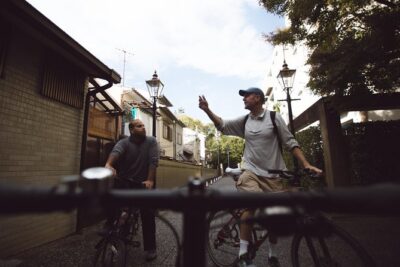
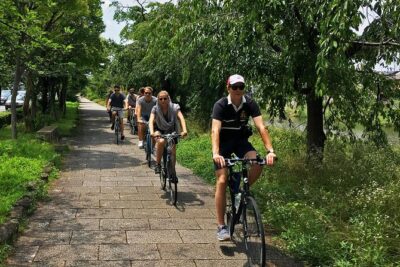
Bike Tour Exploring North Kyoto plus Lunch
Read our review →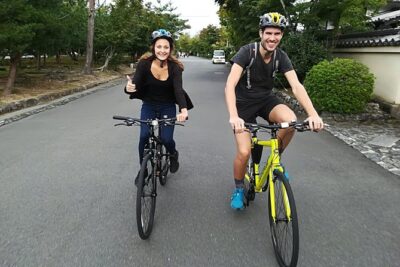
Arashiyama Bamboo Forest & Hidden Gems Bike Tour (Early Bird)
Read our review →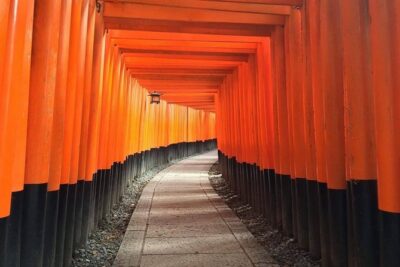
5 Top Highlights of Kyoto Full Day Bike Tour (E-bike option)
Read our review →
Full Day Biking Tour Exploring the Best of Kyoto
Read our review →

Afternoon Kyoto Bike Tour: Bamboo Forest, Monkeys & Hidden Spots
Read our review →
South Kyoto in a Nutshell: Gentle Backstreet Bike Tour!
Read our review →Also filed under