
Reviewed · WORKSHOPS
Knife Workshop with a Master Cutler
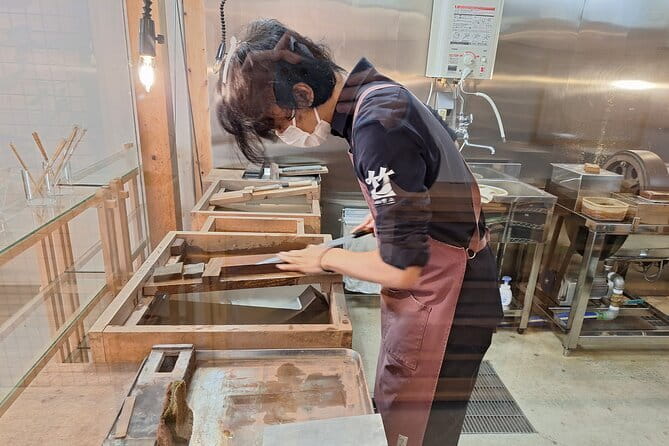
A sharp knife teaches Kyoto fast. In this Kyoto workshop, chef guide Julienne and a master cutler walk you through Japanese knife types and help you sharpen a santoku that gets engraved with your name.
Then you leave with a tool you can actually use, not just a photo.
The big upside is hands-on instruction paired with a real souvenir. The main drawback is focus: this is technique-heavy and lasts about 2 hours, so it is less of a casual sightseeing break.
In This Review
- Key highlights you should care about
- Kyoto knife culture, compressed into a hands-on lesson
- Meeting at FOOD UTENSILS TAKEGAMI in Shimogyo Ward
- Knife types first, so your sharpening makes sense
- Sharpening your own santoku with a master cutler
- The name-engraved knife: souvenir plus real tool
- Price and value: why $566.33 can make sense
- Who should book this workshop in Kyoto
- Should you book Knife Workshop With a Master Cutler?
- FAQ
- How long is the knife workshop?
- What is the price per person?
- Where do we meet in Kyoto?
- Is this a private tour or shared experience?
- Will I receive a mobile ticket?
- Can I take the knife home?
- Is free cancellation available?
Key highlights you should care about
- Your knife gets engraved with your name, so the result feels personal right away
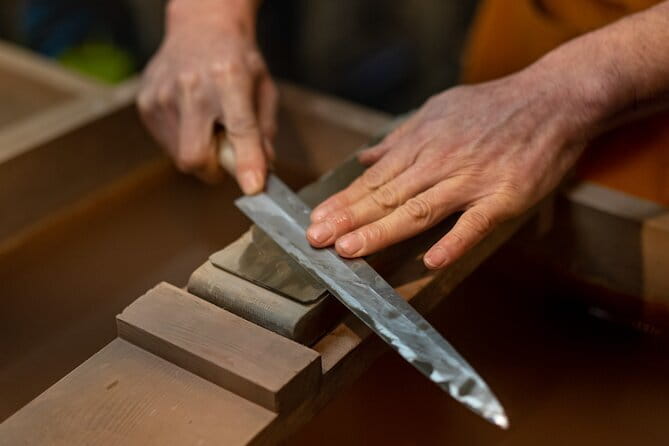
- A master cutler guides your sharpening, not just a demo you watch
- Julienne helps you understand how Japanese knives are used, with context before you start cutting
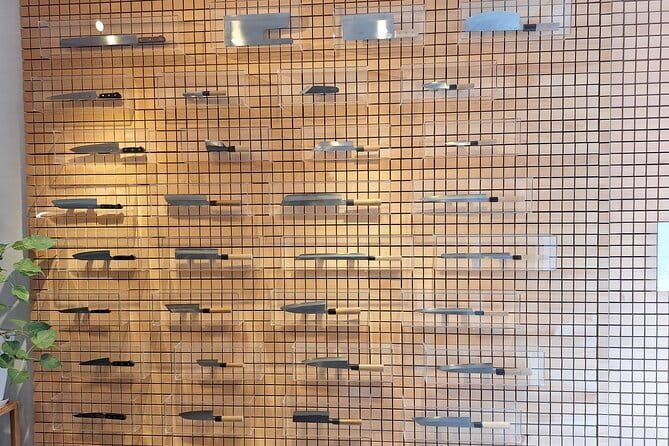
- You learn the roles of many Japanese knife styles, including tools used by both chefs and enthusiasts
- Private experience format, tailored to your group rather than a large crowd
Kyoto knife culture, compressed into a hands-on lesson
Kyoto is one of the best places in Japan to fall in love with knives, because Japanese cooking traditions are treated like crafts, not shortcuts. This workshop keeps that spirit practical. You spend your time learning what different knives are for, then you do the work yourself under guidance.
You will start with an overview of the history and usage of various knife types used across Japanese kitchens. The point is not trivia. It helps you understand why Japanese knife styles exist in the first place, and how chefs think about the job a knife must do. After that, you move into sharpening your own santoku.
That mix is what makes this experience worth planning for. It is easy to come home with a souvenir, and it is also easy to come home with a pile of “cool info” that you never use. Here, you get both: context plus a take-home tool.
Meeting at FOOD UTENSILS TAKEGAMI in Shimogyo Ward
You meet at 食道具竹上 FOOD UTENSILS TAKEGAMI, 238-2 Sugiebisuchō, Shimogyo Ward, Kyoto (600-8386). It ends back at the meeting point, so you are not juggling a half-day transit puzzle.
Two practical notes from the setup:
- It is near public transportation, which matters in Kyoto where locations can feel farther than they look on a map.
- It is a private tour/activity, meaning your group handles the full 2 hours without sharing the room with strangers.
Also plan around your ticket. You get a mobile ticket, so it is one less thing to print or misplace when you are hopping around Kyoto.
A quieter way to spend a day in Kyoto
- Kyoto: 45-Minute Tea Ceremony Lesson Experience
★ 4.3 · 2,378 reviews - Ramen Cooking Class at Ramen Factory in Kyoto
★ 5.0 · 1,937 reviews - Kyoto : Chopsticks Making Workshop in Gion with Engraving Option
★ 5.0 · 958 reviews - Kyoto: Samurai Sword Class by Experts in Traditional Arts
★ 4.9 · 657 reviews
Knife types first, so your sharpening makes sense
Before you sharpen, your chef guide Julienne explains the history and usage of different Japanese knives and tools. The workshop uses more than a dozen knife types as examples, including models used in professional kitchens and in the homes of enthusiasts.
For me, the smartest part of starting here is that sharpening does not live in a vacuum. If you only learn how to sharpen, you might still wonder what you are sharpening for. When you understand how different knife styles are used, the shaping of the edge becomes part of a bigger picture.
You should expect a step-by-step approach:
- You hear what each knife type is meant to do.
- You connect those uses to how cooks choose tools.
- Then you apply that thinking when it is your turn to sharpen the santoku you will take home.
One consideration: if you are hoping for a fast, casual experience with minimal talking, this “first lesson” phase might feel like more classroom time than you expected. Still, that foundation is what makes the end result more satisfying, because you are not just copying steps, you are learning the why.
Sharpening your own santoku with a master cutler
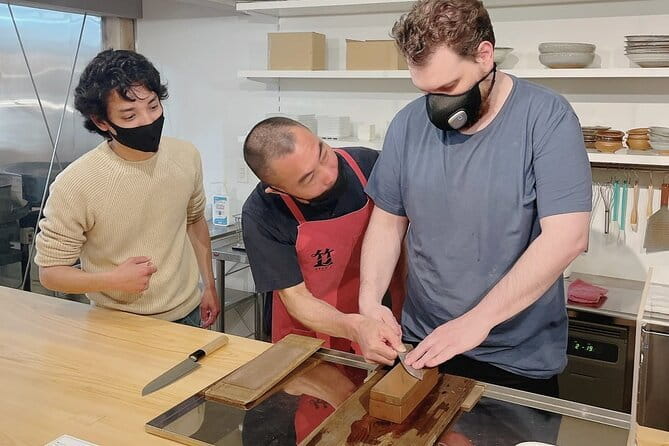
This is the heart of the experience. A master cutler guides you while you sharpen your own santoku. The instruction is hands-on, and you are not left to figure it out alone.
From the way the workshop is described, the master cutler’s teaching style is central to the value. In feedback, the master is repeatedly praised for being kind and patient, with the clear sense that pride in the craft shows through. That matters because sharpening is one of those skills where small corrections can make a big difference.
As you work, keep your expectations grounded. This is not a factory output process. You are learning a skill with guidance, and you are also building confidence for when you sharpen at home later.
What I think you should focus on during the sharpening phase:
- Take the guide’s cues seriously, even if they feel overly detailed at first.
- Ask questions about how the knife is supposed to feel when it is sharper.
- Pay attention to how your santoku fits into real kitchen tasks, since you will keep it.
And yes, it is a souvenir, but it is not a toy. You are creating a usable knife, which makes it a stronger memory than a single-day craft class where the result is decorative.
The name-engraved knife: souvenir plus real tool
At the end, your knife is engraved with your name, then you take it home. That detail changes the entire emotional tone of the workshop. A plain “souvenir knife” is forgettable. A personalized santoku becomes part of your kitchen routine, and you notice it every time you cook.
This is one of the most practical ways to remember a trip:
- You can use it at home.
- You can connect it to the hands-on learning you did in Kyoto.
- You have a clear story attached to the object, not just a generic purchase.
Also, remember what you are carrying. You will be taking home a knife, so plan your packing and travel day accordingly. If you are flying, you will want to follow the rules in your home country for transporting sharp items. The workshop itself does not spell out shipping or handling, so treat this as your personal responsibility for safe transport.
Price and value: why $566.33 can make sense
The price is $566.33 per person for about 2 hours. That is not cheap. But knife workshops with a master cutler are usually expensive for a few reasons that matter to you as a buyer.
Here is the value logic that supports the price:
- You get instruction from a master cutler, not just a basic demonstration.
- You do hands-on sharpening, which usually takes time and supervision.
- You take home a santoku you sharpen.
- Your knife includes name engraving, which adds both cost and meaning.
If you compare it to buying a similar knife plus paying for instruction elsewhere, it starts to look less outrageous. The bigger question is whether you want this kind of experience. If you love food, cooking tools, and crafts, you will feel like the money is buying a skill and a story. If you only want scenic Kyoto highlights, the price is harder to justify.
Booking timing is another clue. The experience is often booked about 33 days in advance, which suggests limited slots around the master cutler’s schedule. If you want a specific date, plan ahead.
A day of temples goes further with something to break it up.


Who should book this workshop in Kyoto
This is a good fit if you:
- Want a hands-on Kyoto activity, not just photos
- Care about Japanese cooking tools and how they work
- Enjoy learning crafts where patience and technique matter
- Like personal souvenirs that you can actually use
It may be a weaker fit if you:
- Want a full sightseeing day, because this is focused and time-bound
- Prefer low-touch activities where you only watch
- Are not interested in sharpening or kitchen tools at all
One more practical note. Since the experience is private and your time is tightly structured, it is best when you can give it your attention. If you are constantly sprinting between train stations, this workshop is likely to feel stressful.
Should you book Knife Workshop With a Master Cutler?
If you want something authentically Kyoto and genuinely practical, I think this is an easy yes. The combination of Julienne’s guidance, a master cutler’s patience, and the end result of a name-engraved santoku makes the experience feel worth planning around.
Book it if you will use the knife at home or if you enjoy learning craft skills. Skip it if you are only looking for a casual, low-effort cultural stop.
FAQ
How long is the knife workshop?
It lasts about 2 hours.
What is the price per person?
The price is $566.33 per person.
Where do we meet in Kyoto?
You meet at 食道具竹上 FOOD UTENSILS TAKEGAMI, 238-2 Sugiebisuchō, Shimogyo Ward, Kyoto, 600-8386, Japan. The activity ends back at the meeting point.
Is this a private tour or shared experience?
It is a private tour/activity, so only your group participates.
Will I receive a mobile ticket?
Yes, the experience includes a mobile ticket.
Can I take the knife home?
Yes. You sharpen your own santoku knife, and it is engraved with your name. You take it home at the end.
Is free cancellation available?
Yes. Free cancellation is available up to 24 hours before the experience’s start time for a full refund. Changes made less than 24 hours before the start time are not accepted.
New This Season
- Koyasan Day Trip by Private Car from Kyoto
- Old Port Town and Ultimate Sake Tasting Private Tour From Kyoto
- Sacred Peak & Ancient Paths: Kurama-Kibune Hiking Experience
- Kyoto’s Timeless Charm: 3hr Exploration of History and Peace
- Kyoto: 5 Types of Sushi Making
- Kyoto: Exclusive ZEN practice at Manpukuji temple in Uji
- Kyoto: Private Seasonal Aroma Yoga Class
- Traversing Kyoto’s Scenic West – Arashiyama to Kinkakuji
Workshops, compared.
Ramen Cooking Class at Ramen Factory in Kyoto
Read our review →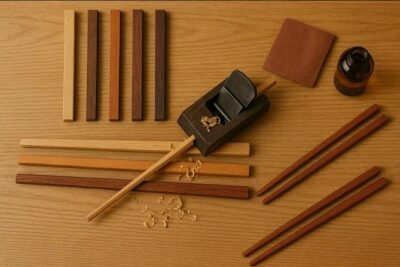
Chopsticks Making Workshop in Gion with Engraving Option
Read our review →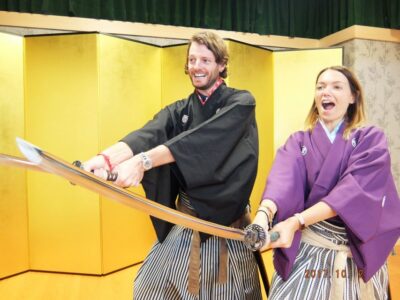
Samurai Sword Class by Experts in Traditional Arts
Read our review →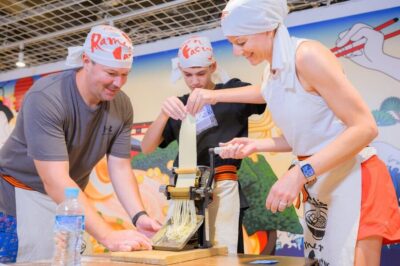
Ramen Cooking Class at a Ramen Factory with Souvenir
Read our review →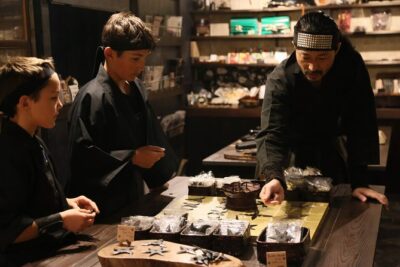
Ninja 1-hour Hands-on Lesson by Japanese master in Kyoto -Entry
Read our review →
The Original Small-Group Sushi Making Class in Kyoto
Read our review →Also filed under