
Reviewed · TEMPLE & SHRINE VISITS
Kyoto: Tofuku-ji Temple and Komyo-in Guided Walking Tour
Kyoto does silence well, and this walk explains why. You start at the Sanmon Gate, Japan’s oldest surviving Zen main gate, then head straight into the Hojo gardens and their bold, modern geometry by Mirei Shigemori. It’s not just pretty scenery. You get a guided way to see how Zen garden design works as quiet thinking, using stone, moss, gravel, and intentional empty space.
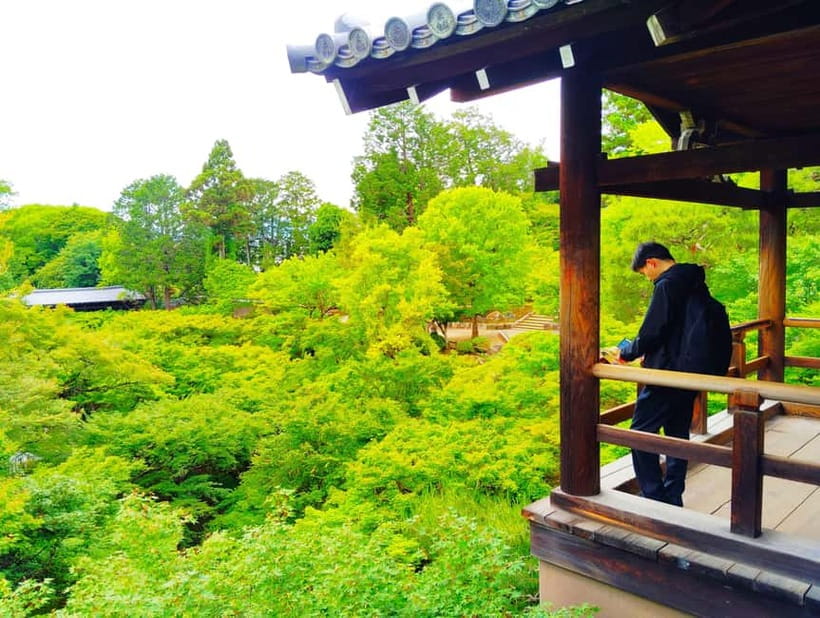
My favorite part is how the tour connects architecture, gardens, and the feeling of Zen practice into a single route you can follow on foot. You also cross the Tsutenkyo Bridge, a wooden corridor over the forested ravine, which makes the landscape feel like it’s changing under your feet and around the seasons. One real consideration: this is a walking tour through temples and gardens, so it is not suitable if you have mobility impairments.
In This Review
- Key highlights you will actually notice
- From Kusaka Gate to Sanmon Gate: where the walking tour really starts
- Sanmon Gate at Tofuku-ji: the oldest Zen main gate, explained through form
- Hojo gardens and Mirei Shigemori: four dry garden designs around the abbot’s quarters
- What to look for in the Hojo gardens: stone, moss, gravel, and intentional space
- Tsutenkyo Bridge: a wooden corridor over the Sengyokukan ravine
- Komyo-in and Hashin-tei Garden: the quieter Shigemori expression
- Why the guide matters: turning gardens into spatial meditation
- Price and value: is $94 per person fair for 2 hours?
- Timing, walking comfort, and garden etiquette that will keep you stress-free
- Who this tour suits best, and who should skip it
- Should you book this Kyoto Tofuku-ji and Komyo-in guided walk?
- FAQ
- Where is the meeting point for this tour?
- How long does the Kyoto Tofuku-ji and Komyo-in guided walking tour take?
- Is this tour private, and what languages are offered?
- What’s included in the tour price?
- What is not included?
- What should I bring and wear?
- Can I take photos, and am I allowed to touch plants?
- Is smoking allowed during the tour?
- What are my options if I need to cancel, and can I pay later?
Key highlights you will actually notice
- Sanmon Gate at Tofuku-ji: the oldest surviving Zen main gate in Japan, made for slow looking
- Mirei Shigemori’s Hojo gardens: four dry garden compositions with abstraction and silence
- Tsutenkyo Bridge crossing: a wooden corridor over the Sengyokukan ravine that feels like a moving viewpoint
- Komyo-in and Hashin-tei Garden: a quieter Shigemori expression with asymmetrical stones in raked gravel
- Guided Zen interpretation: design explained as space, impermanence, balance, and calm, not just decoration
From Kusaka Gate to Sanmon Gate: where the walking tour really starts
You meet at the Kusaka Gate (Kusakamon) of Tofuku-ji Temple. The Japanese name for this entrance is 日下門, and your guide waits holding a yellow sign that reads DeepExperience. That matters more than you might think. Tofuku-ji is big, and arriving with a clear starting point helps you avoid the “which gate is the right one?” scramble.
From the first steps, the tour keeps a steady rhythm: look, walk, pause, then learn. That pace is perfect for a 2-hour experience because it gives your eyes time to adjust to what Zen spaces ask for. In many parts of Kyoto, you rush through, snap photos, and move on. Here, you are guided to slow down in a practical way, so the gardens and temple architecture make sense instead of just looking old and pretty.
Sanmon Gate at Tofuku-ji: the oldest Zen main gate, explained through form
The Sanmon Gate is the kind of landmark you can spot from a distance, but what you will appreciate is how it frames the whole experience. Sanmon gates were not built only to impress. They were built to shape movement and attention. You approach it, you stand with it in front of you, then you pass into the temple grounds with a sense of entering a different mental mode.
This tour makes that transition clear. Your guide shares context for why these structures matter in Zen heritage, and why gate architecture and garden layout work together. If you tend to think of temples as single buildings, this is a helpful correction. In Zen space, everything is choreographed, from entry points to open areas to the geometry inside the gardens.
Practical tip: give yourself a minute or two before you lift your camera. The gate’s details and proportions are best when you slow down. If you shoot immediately, you usually end up with flatter photos that miss the scale.
More rooftops worth a detour
- Kyoto: Tea Ceremony Ju-An at Jotokuji Temple
★ 4.9 · 3,207 reviews - Arashiyama Bamboo, Temple, Monkeys, or Secret Sake Brewery
★ 4.8 · 886 reviews - Kyoto: Arashiyama Bamboo Forest, Monkeys, Matcha & Temple Tour
★ 5.0 · 759 reviews - Osaka/Kyoto: Arashiyama, Nara & Fushimi Inari Shrine w/Lunch
★ 4.4 · 754 reviews
Hojo gardens and Mirei Shigemori: four dry garden designs around the abbot’s quarters
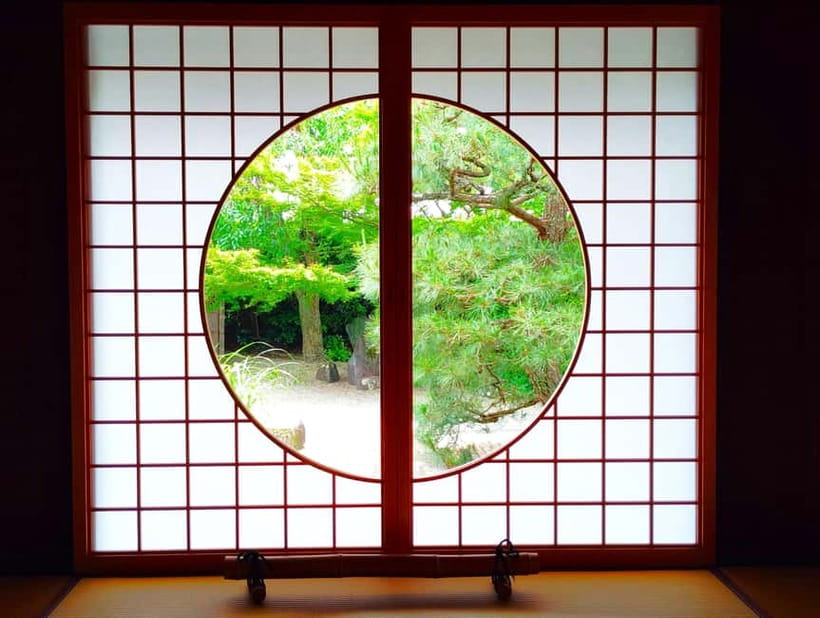
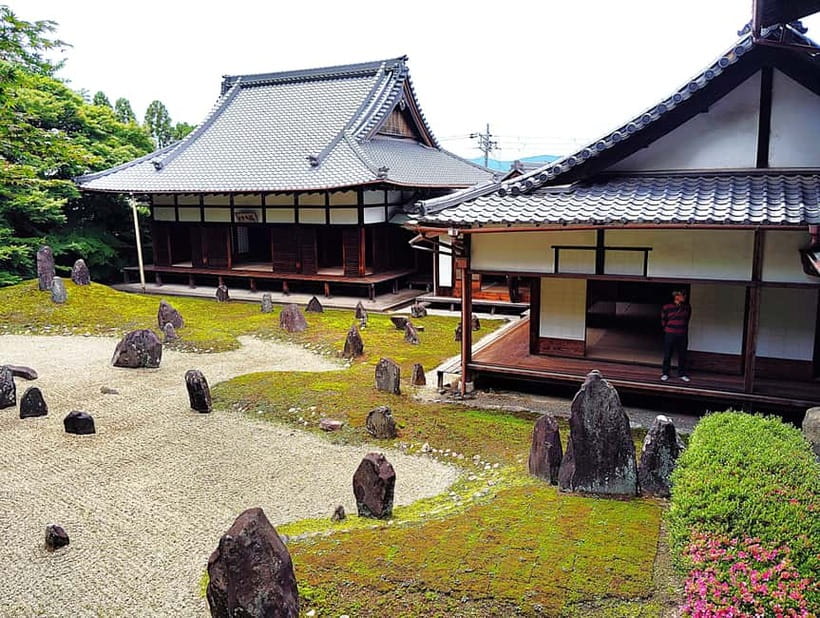
After the gate, you move into the Hojo gardens, laid out around the abbot’s quarters. The big idea here is Zen abstraction. These are dry garden designs that do not try to copy nature. Instead, they distill nature’s essence through simplified materials and intentional emptiness.
Your guide points out that Mirei Shigemori blended ancient symbolism with bold modern geometry. That combination is exactly what makes this stop so interesting. You are looking at stones and moss and raked gravel, but you are also looking at a thinking system: form that suggests without fully describing, calm that does not rely on decoration.
You spend about 1.5 hours at Tofuku-ji total, with time for photos and a guided walk through the core highlights. The key is that you are not just circling the gardens. You are learning how the garden areas function as meditative compositions. That changes how you see them. Stones stop being “features” and start becoming elements in a quiet argument about balance and impermanence.
What to look for in the Hojo gardens: stone, moss, gravel, and intentional space
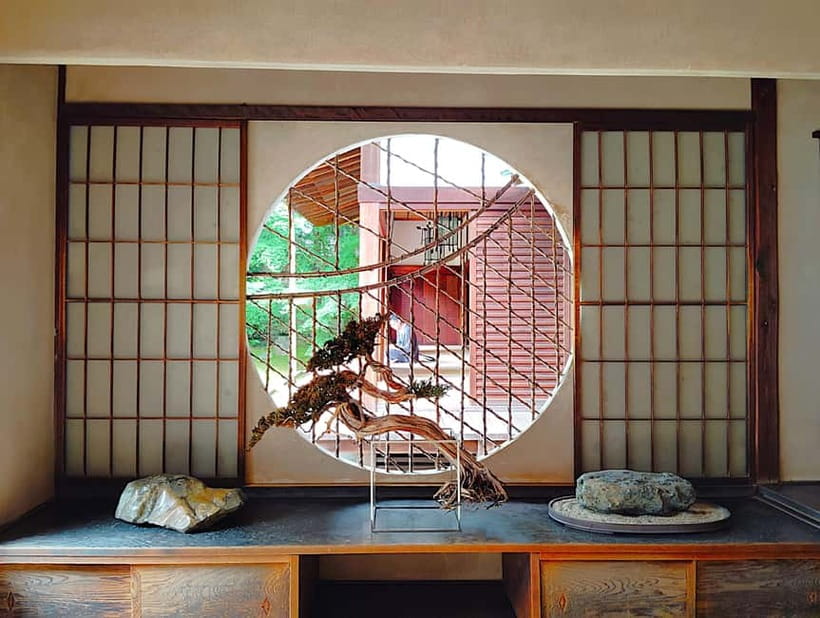
The Hojo gardens are described as four distinct dry garden compositions. Each one uses stone, moss, gravel, and space to create a meditative arrangement. Your guide’s job is to help you read the design without forcing your own interpretation too hard.
Here is what I think you should focus on during the quiet parts:
- The negative space: the emptiness is not leftover. It is part of the message.
- Stone placement: groups and single stones can feel like islands, anchors, or punctuation in a sentence.
- The rhythm of lines: raked gravel and edges guide your eyes like slow handwriting.
- Material changes over time: moss spreads, stones weather, gravel tones shift, so the garden is never fully fixed.
You might think you need to “understand Zen philosophy” before you enjoy it. You do not. You just need a way to look. The guide gives you that look, then you let the garden do the rest.
Tsutenkyo Bridge: a wooden corridor over the Sengyokukan ravine
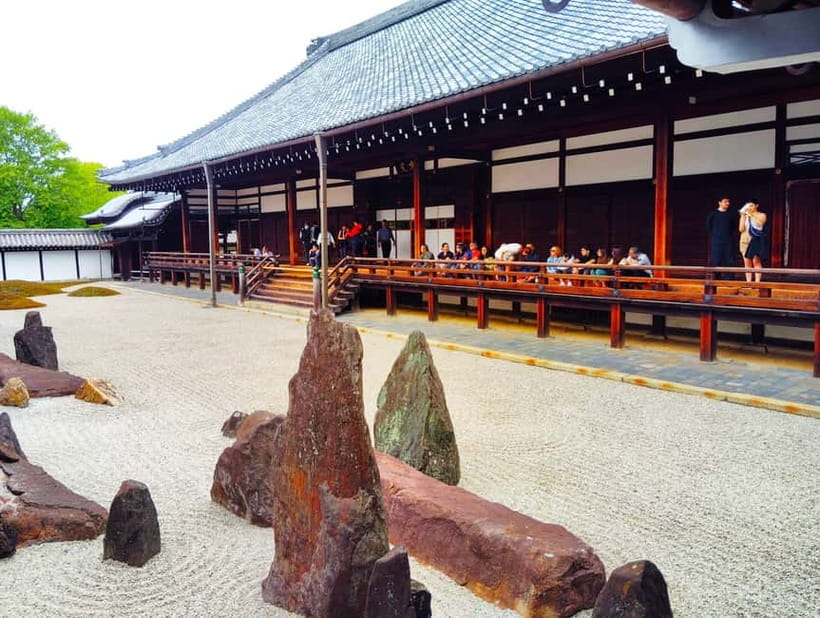
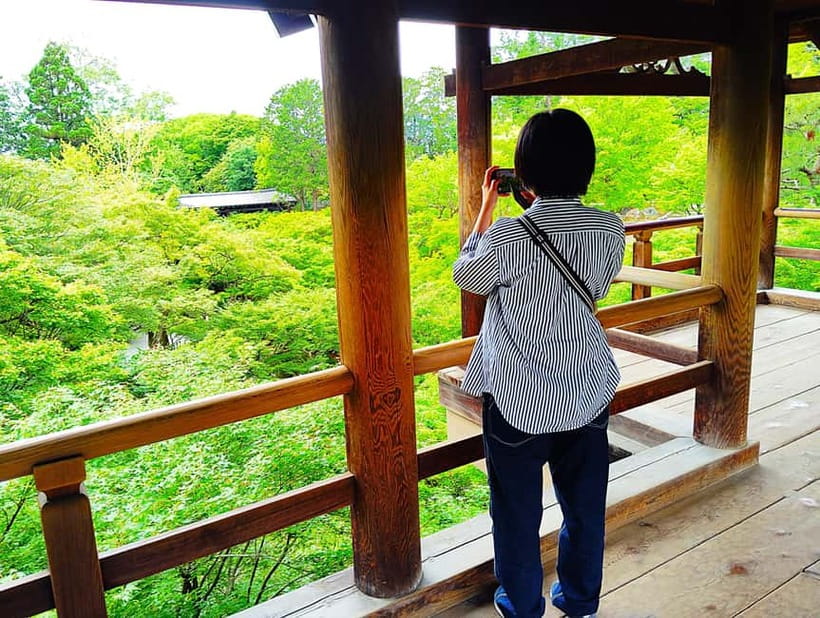
Next comes one of the most memorable moments on the walk: crossing the Tsutenkyo Bridge. This is an elevated wooden corridor that arches gracefully over a forested ravine tied to the Sengyokukan stream.
What makes this crossing worth your time is the way architecture and landscape combine into something like a living viewpoint. The color and mood change by season. You are given that seasonal lens while you walk, so the bridge does not feel like a generic crossing. It feels like a frame, and the view changes as your body moves through it.
If you are visiting in autumn, you will likely notice crimson maples. In spring, the tone shifts toward softer greens. In early morning conditions, mist can make the ravine feel like it is fading away. Even if your day does not match your favorite season, the bridge still helps you see Kyoto garden design as experience, not just destination.
Photography tip: take a photo at the start of the crossing, then one about halfway. Many people only shoot from one side, and the angle from mid-bridge often shows more of the ravine depth.
Komyo-in and Hashin-tei Garden: the quieter Shigemori expression
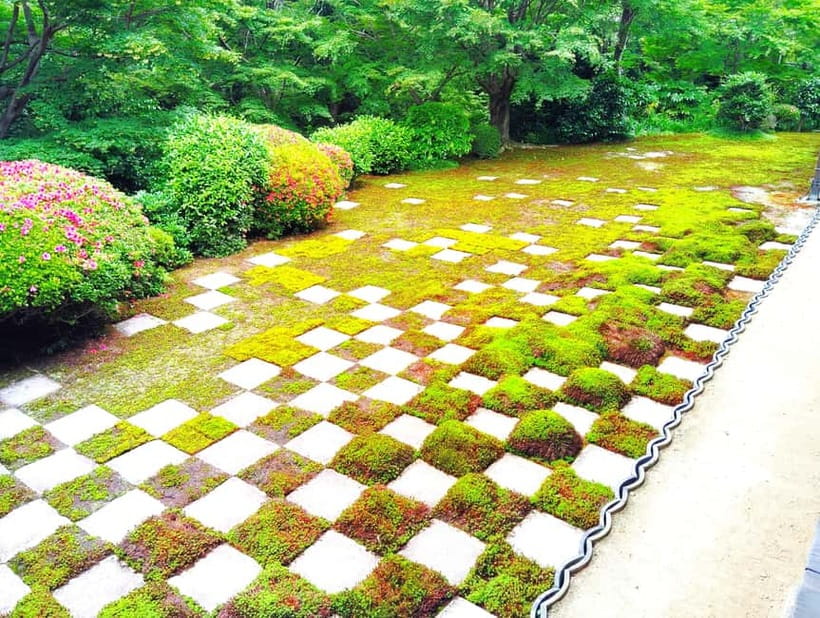
Your final temple stop is Komyo-in, a place that many visitors skip when they are only rushing for the big-name sights. Here, you get a shorter visit window, around 30 minutes, but the focus is tighter and calmer.
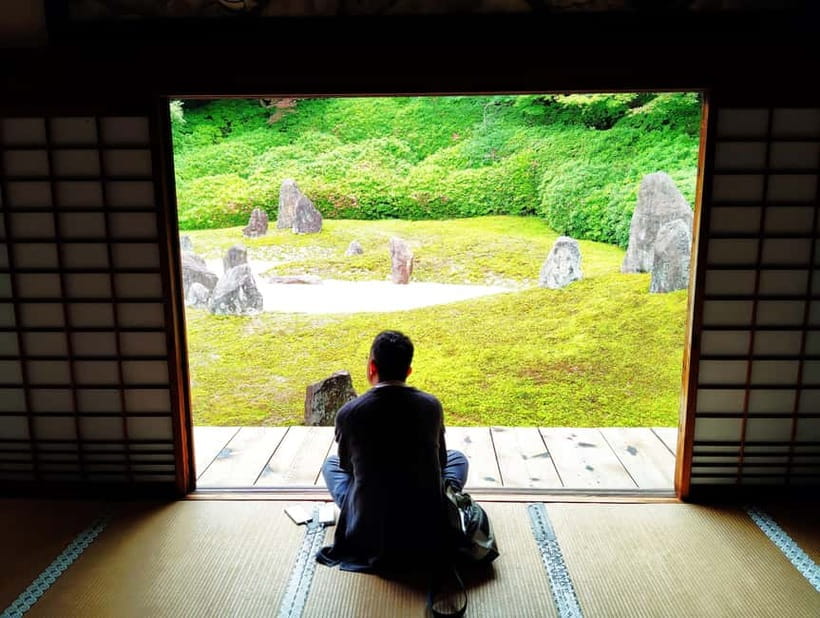
Komyo-in centers on the Hashin-tei Garden, also designed by Mirei Shigemori. If the Hojo gardens feel bold and structured, Hashin-tei leans into a quieter intimacy. You are guided to notice how stones rise from moss and raked gravel like islands in stillness, with asymmetry playing a key role.
That “sea of stillness” feeling is practical to seek. If you stand in the wrong spot or spend all your time moving, you miss the garden’s intended rhythm. The best approach is to pause at the guide’s cues and let your eye rest. In Zen garden design, stillness is part of the viewing tool.
A quieter way to spend a day in Kyoto




Why the guide matters: turning gardens into spatial meditation
What elevates this tour above a self-guided stroll is the way your expert guide connects what you are seeing to what it means. You are not only learning names and locations. You are learning philosophical and artistic principles that explain why these gardens are more than scenic stops.
The tour frames the gardens as spatial meditations. The guide talks about impermanence, balance, and the Japanese sensitivity to the space between things. That last point can sound abstract, but it becomes obvious once you look at raked gravel, empty areas, and stone placements as part of the composition.
This is also where the tour feels most worth it at the end of a busy Kyoto day. Instead of collecting more temples to check off, you leave with a clearer way to understand why Zen spaces feel the way they do.
One more note from an earlier firsthand account: a guide named Nobu impressed with how she tied temple context to Kyoto and Japan more broadly, and she was flexible with timing. That kind of guidance helps the tour feel human, not scripted.
Price and value: is $94 per person fair for 2 hours?
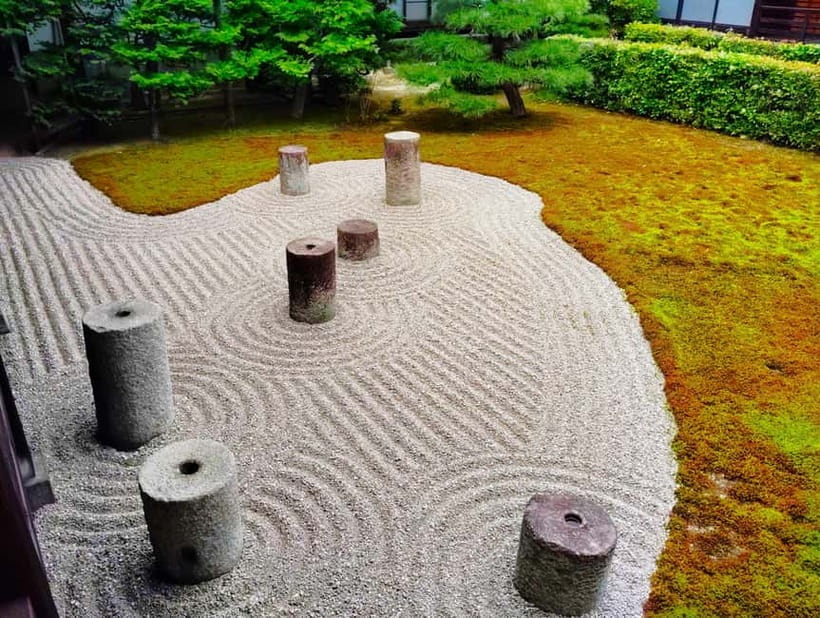
At $94 per person for a 2-hour guided walk, the value depends on your travel style. If you like museum-style interpretation and you want someone to translate what you are looking at, this price can feel fair fast. You get:
- a guided walking route across multiple temple highlights
- expert insights into Zen philosophy and garden design
- time for photos and guided pauses at the most meaningful points
If you are the kind of traveler who just wants to wander freely and read signage, you might feel you can do it independently. Tofuku-ji and Komyo-in are real places you can visit on your own.
But if you want the “how to look” part, the guided format is the point. Two hours is also the sweet spot. You are not committing to a half day, yet you still see the Sanmon Gate, Hojo gardens, Tsutenkyo Bridge, and Komyo-in in a coherent flow.
Timing, walking comfort, and garden etiquette that will keep you stress-free
This tour involves walking through temples and gardens, so comfortable shoes are not optional. The pace includes about 1.5 hours at Tofuku-ji and about 30 minutes at Komyo-in, plus time for guided photos and transitions.
What to bring is simple and practical:
- comfortable shoes
- camera
- water
- weather-appropriate clothing
Etiquette rules are also straightforward:
- no smoking
- photography is allowed, but be respectful
- do not touch the plants
Those rules matter because temple gardens can be fragile, and you will feel more relaxed if you follow them without thinking.
Who this tour suits best, and who should skip it
This is a strong fit if you:
- want a guided explanation of Zen gardens, not just photos
- enjoy design and symmetry, but also appreciate asymmetry and empty space
- prefer a short, focused walk over a long, packed day
It is not suitable if you have mobility impairments. The tour is explicitly walking-based through temple and garden grounds, and you should plan for that reality before booking.
Should you book this Kyoto Tofuku-ji and Komyo-in guided walk?
Book it if you want a focused, design-first way to experience Kyoto’s Zen heritage. The Sanmon Gate, Hojo gardens with Mirei Shigemori’s four compositions, the Tsutenkyo Bridge crossing, and Komyo-in’s Hashin-tei Garden all connect into one clear story. And you will not be left guessing what you are looking at, because the guide translates the thinking behind the stones and gravel.
Skip it if you want a fully self-paced temple day with no interpretation, or if walking distance and garden surfaces are a problem for you.
If your goal is to leave with a calmer mind and a better eye for Japanese garden design, this is a smart use of time in Kyoto.
FAQ
Where is the meeting point for this tour?
You meet at the Kusaka Gate (Kusakamon) of Tofuku-ji Temple. Your guide will be waiting holding a yellow sign that says DeepExperience. Use the map for the exact location.
How long does the Kyoto Tofuku-ji and Komyo-in guided walking tour take?
The tour duration is 2 hours.
Is this tour private, and what languages are offered?
Yes, it is a private group tour. The live guide offers English and Japanese.
What’s included in the tour price?
The price includes a guided walking tour and expert insights into Zen philosophy and garden design.
What is not included?
Transportation to the meeting point and meals and drinks are not included.
What should I bring and wear?
Bring comfortable shoes, a camera, and water. Wear weather-appropriate clothing.
Can I take photos, and am I allowed to touch plants?
Photography is allowed, but you should be respectful. Touching plants is not allowed.
Is smoking allowed during the tour?
No, smoking is not allowed.
What are my options if I need to cancel, and can I pay later?
You can cancel up to 24 hours in advance for a full refund. You can also reserve now and pay later to keep plans flexible.
New This Season
- Koyasan Day Trip by Private Car from Kyoto
- Old Port Town and Ultimate Sake Tasting Private Tour From Kyoto
- Kyoto’s Timeless Charm: 3hr Exploration of History and Peace
- Kyoto: 5 Types of Sushi Making
- Sacred Peak & Ancient Paths: Kurama-Kibune Hiking Experience
- Kyoto: Exclusive ZEN practice at Manpukuji temple in Uji
- Kyoto: Private Seasonal Aroma Yoga Class
- Traversing Kyoto’s Scenic West – Arashiyama to Kinkakuji
Temple & Shrine Visits, compared.
Arashiyama Bamboo, Temple, Monkeys, or Secret Sake Brewery
Read our review →
Arashiyama Bamboo Forest, Monkeys, Matcha & Temple Tour
Read our review →
Arashiyama, Nara & Fushimi Inari Shrine w/Lunch
Read our review →
Kyoto Zen Meditation & Garden Tour at a Zen Temple with Lunch
Read our review →
KYOTO Tea Ceremony with kimono near by Imamiya Jinjya Shrine
Read our review →Arashiyama Bamboo, Matcha, Monkeys & Temple Tour
Read our review →Also filed under