
Reviewed · WALKING TOURS
Kyoto Late Bird Walking Tour
Kyoto at 2pm feels like a smart reset. This late-afternoon walk strings together big-name stops with guide commentary so you do more than just drift through crowds. You also get the bonus of private-group flexibility, which is a big deal when you want answers, not guesswork.
I especially like the pace: about 4 hours that covers multiple landmarks without turning your day into a stamina contest. One thing to watch is that public transport costs extra, listed at ¥850 per person, so your total is not just the ticket price.
In This Review
- Key things that make this Kyoto late-bird walk worth your time
- Price and what you really get for your money
- Meeting at Kyoto Station, then moving like you know the city
- Stop 1: Fushimi Inari-taisha and the torii maze effect
- Stop 2: Yasakanoto (Yasaka Pagoda), built long ago, photographed forever
- Stop 3: Yasaka Shrine, Gion’s name origin, and the deities you will actually hear about
- Stop 4: Gion, geisha-maiko culture, and old streets that feel different with context
- The extra stops that can pop in, like Yasui Konpira-gu and a paper wish
- How the guide makes the difference (and why private helps)
- Timing tips for a 2:00 pm start
- Who this tour is best for
- Quick reality check on crowds and expectations
- Should you book the Kyoto Late Bird Walking Tour?
- FAQ
- What time does the Kyoto Late Bird Walking Tour start?
- How long is the tour?
- Where do I meet the guide?
- Is the tour private?
- What is included in the price?
- Are entrance tickets needed for the stops?
- Do I need to pay for public transportation?
- Is there a mobile ticket?
- What happens if the weather is poor?
- Is it stroller accessible?
Key things that make this Kyoto late-bird walk worth your time
- Stop-to-stop guidance from Kyoto Station, so you can find your way fast
- Free admission at each main stop, so your money stays for food and transit
- Gion strolling with geisha and maiko context, and a real chance to spot them
- Photo-friendly views from Yasaka Pagoda, timed for the evening crowd
- Relaxed afternoon structure that still hits the major sights
- Mobile ticket for easier check-in on the day
Price and what you really get for your money
The price is $86.49 per person for a private tour covering several top Kyoto sights. The included part is the guide fee, and the route includes free entry at the main landmarks (Fushimi Inari-taisha, Yasakanoto, and Yasaka Shrine are all listed as admission-free).
What that means for you, practically: you are paying for organization and interpretation. Kyoto looks confusing if you are doing it solo, because temples, shrines, streets, and alleyways all overlap in a way that is hard to untangle on your own. Here, the guide helps you connect the dots, and that is where the value lives.
Your likely extra cost is the public transportation fare, listed as ¥850 per person (not included). In one helpful tip from past guests, an IC card with loaded credit makes train hops easier, and that lines up with how the tour gets between neighborhoods.
Meeting at Kyoto Station, then moving like you know the city
The tour starts at 2:00 pm at Kyoto Station and ends back at the same meeting point. That end point matters. You do not need to solve the last-mile logistics after you finish wandering Gion.
You should plan for an afternoon rhythm. Even with a guide, you will still be walking. It is not described as stroller-friendly, and it is not listed as stroller accessible, though it is described as accessible for limited eye sight and limited mobility. If you are traveling with someone using a wheelchair or needing slower pacing, it is worth communicating needs ahead of time when you book.
The private-group setup is also a quiet advantage. It generally means the guide can adjust pacing so you are not forced to keep up with a much larger crowd.
A quieter way to spend a day in Kyoto
- Kyoto Geisha Walking Tour: Gion District & Hidden Gems
★ 4.7 · 3,273 reviews - Kyoto: Gion Magical Night Walking Tour with Geisha Trivia
★ 4.9 · 2,393 reviews - Kyoto: Gion Geisha District Walking Tour – Stories of Geisha
★ 4.7 · 2,187 reviews - Night Walk in Gion: Kyoto’s Geisha District
★ 4.5 · 2,003 reviews
Stop 1: Fushimi Inari-taisha and the torii maze effect
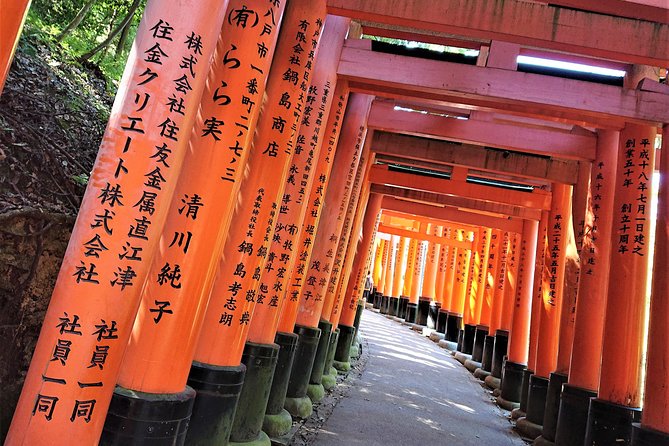
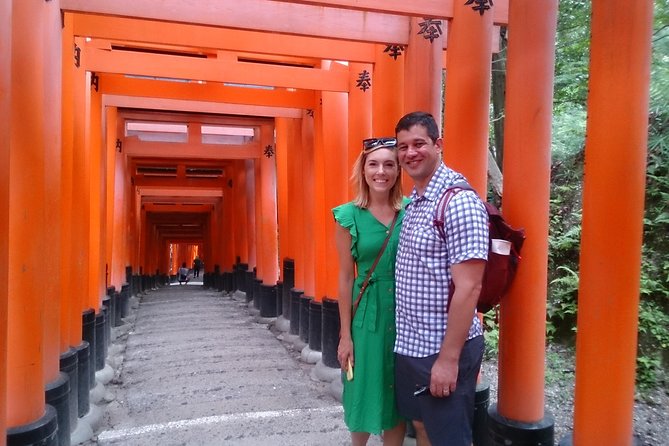
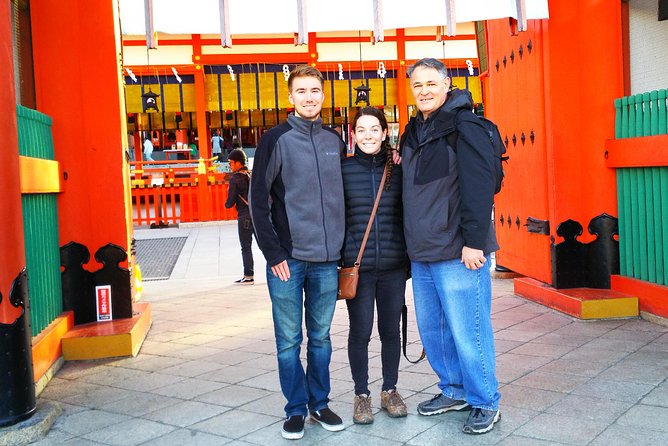
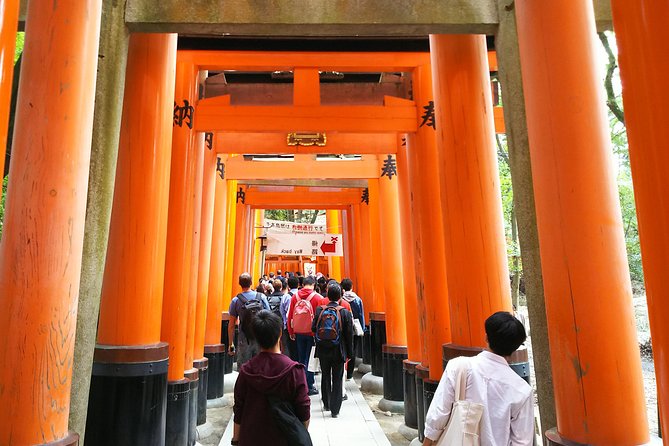
You begin at Fushimi Inari-taisha, famous for its tunnel of thousands of vermilion torii gates. Even if you have seen photos, walking in that corridor changes the feeling. The repetition pulls you forward, and the scale gets more obvious with every turn.
This is listed as about 1 hour, and that makes sense. You need time to move at a comfortable pace, pause for photos, and absorb the explanation behind what you are seeing. The tour notes that the torii gates were offered by worshippers in appreciation for good fortune from the deity enshrined there. A guide can help you make sense of what you are looking at, instead of just enjoying red gates like you are on a photo scavenger hunt.
What to consider: it can still be crowded because it is a top draw. The upside of starting mid-afternoon is that you can avoid some of the earliest chaos, though you should still expect busy pockets.
Stop 2: Yasakanoto (Yasaka Pagoda), built long ago, photographed forever
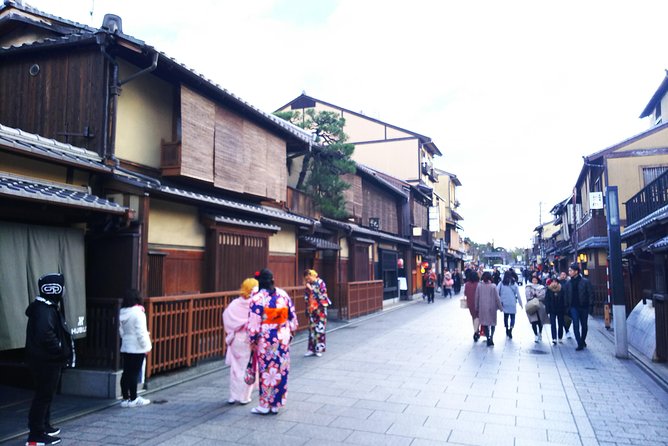
Next is Yasakanoto, also known as Yasaka Pagoda. This one is shorter, about 30 minutes, but it has a lot going on.
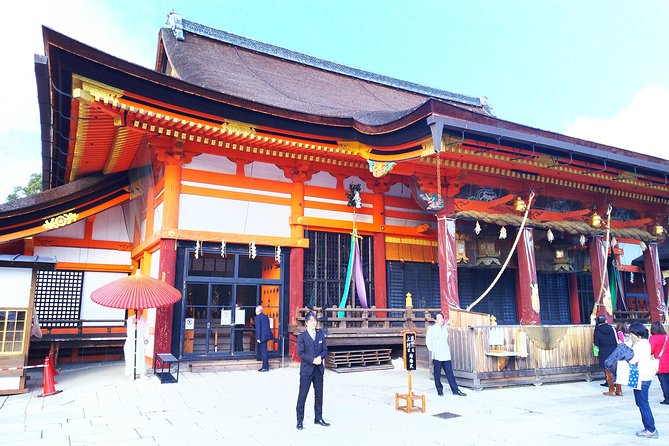
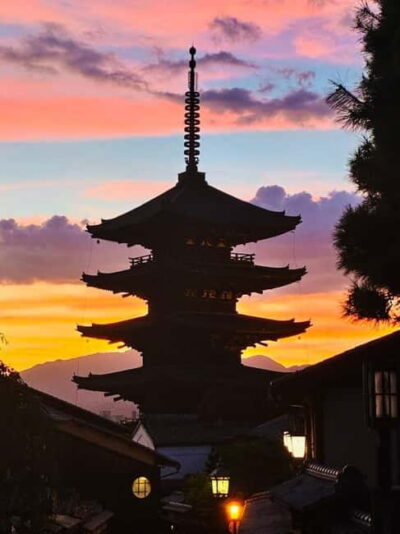
The big historical detail here is that the pagoda was originally built in 592 and rebuilt in 1440. That is the kind of fact that makes the structure feel less like a postcard object and more like a living piece of Kyoto’s timeline. From this area, you also get landscape-style views of Kyoto (the tour description frames it this way), and at evening it becomes a magnet for photographers.
For your experience, the main value is timing. A guide can help you get into position without feeling rushed, and you are not stuck figuring out the best angle yourself.
Stop 3: Yasaka Shrine, Gion’s name origin, and the deities you will actually hear about
Then comes Yasaka Shrine, about 20 minutes. This stop is quick, but it has an important story.
The tour explains that Yasaka Shrine was once called Gion Shrine, and the current name of Gion takes its name from this shrine. That connection is the kind of detail that pays off later, because you walk through Gion with a clearer sense of where the name comes from.
The guide also covers the spiritual angle. The tour notes that the main deity here is considered powerful, and a god of beauty is also enshrined, which helps explain why people are interested in this place.
Possible drawback: because the stop is only 20 minutes, you will want to listen closely. If you try to read everything on your own first, you might miss the parts that make the shrine meaningful in the local context.
Stop 4: Gion, geisha-maiko culture, and old streets that feel different with context
You finish with a 50-minute walk in Gion, one of Kyoto’s most recognizable traditional districts. The big theme is understanding what you are seeing, not just walking past it.
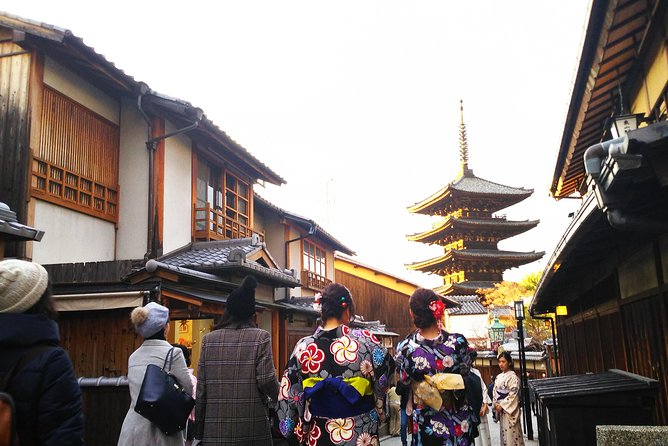
The tour describes geisha as an important part of traditional culture, and it also mentions that you might encounter geisha or maiko, apprentices. That is the part most people hope for, but the real value is what the guide adds around the streets. Gion is known for preserved old-style houses, and with a guide you are more likely to notice the details that tell you why the area looks the way it does.
A couple guide examples from the kinds of tours people have had: a guide named Saori is described as energetic and fluent in both English and Japanese, with a conversation style that connected travel stories to what you were seeing. Another guide named Meg was described as professional and on-time, greeting guests right where expected. There is also a guide named Mitsue known for an easy pace, plus pointing out places you might not otherwise discover.
That matters because Gion can be easy to over-scan with your camera. With interpretation, you shift from chasing sightings to actually understanding the neighborhood.
A day of temples goes further with something to break it up.

The extra stops that can pop in, like Yasui Konpira-gu and a paper wish
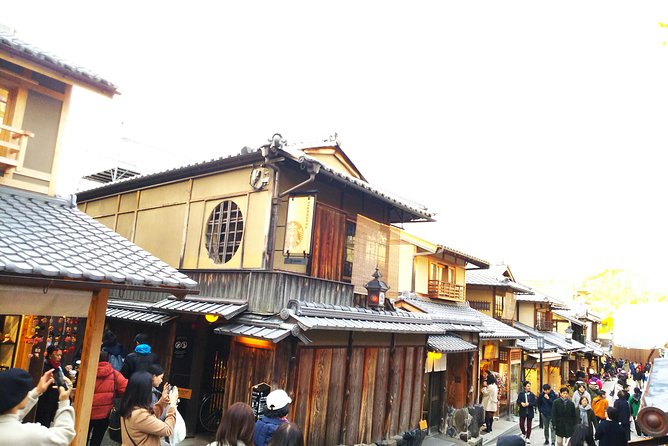
While the main stops are Fushimi Inari, Yasakanoto, Yasaka Shrine, and Gion, some routes add additional Kyoto flavor along the way. In the past, guides have taken guests through Yasui Konpira-gu, including a fun paper wish moment where the guide translated the wish in a humorous way.
If that kind of cultural side quest appeals to you, this tour style is a good fit. It keeps the walk from feeling like a checklist and adds a small memory-making activity.
How the guide makes the difference (and why private helps)
This is a guide-led experience, and the guides people have reported tend to bring two things: clear explanations and good pacing.
For example, one guide named Kaz was described as patient when a guest arrived late, then got everyone moving smoothly. Another guide, Saori, is specifically praised for her enthusiasm and conversational skills, and for relating background through personal stories tied to college in the USA. A guide named Mitsue was noted for welcoming energy and an easy walking pace, with a focus on places to notice before you reach them.
Even if you do not care about history trivia for its own sake, that kind of guidance is practical. You spend less time asking yourself where to go next and more time enjoying the sight.
With a private tour, you also reduce that awkward feeling of trying to keep up in a mixed group. You get your questions answered when they matter, not at the end after everyone is tired.
Timing tips for a 2:00 pm start
Because the tour begins in the afternoon, you are building your day around Kyoto’s evening shift. That can be helpful for comfort, especially during hot seasons, and it also pairs well with planning dinner back near Kyoto Station or in Gion.
Here are a few smart ways to set yourself up:
- Bring a loaded IC card for train segments, since public transport is part of the route.
- Wear shoes that work on uneven pavement. Shrines and older streets can be textured and sloped.
- Keep one light layer handy. Even in warm months, evenings near shrine areas can feel cooler than you expect.
Also, note the tour is described as requiring good weather. If weather turns, you should be ready for a date change or refund scenario.
Who this tour is best for
This is a strong choice if you want a structured Kyoto afternoon without committing to a full day.
You will likely like it if you:
- Want multiple major sights in one go, including Fushimi Inari and Gion
- Prefer someone else handling directions and context
- Enjoy walking at a relaxed pace while still covering the highlights
- Are traveling with a group and want a private format
It may not be the best fit if you are traveling with a stroller, since it is not stroller accessible. If accessibility needs are complex, you should confirm details when booking, but the experience is listed as accessible for limited eye sight and limited mobility.
Quick reality check on crowds and expectations
Let’s keep expectations grounded. You are visiting top Kyoto attractions, so you will not have them all to yourselves. The real advantage is how the guide manages time and routes you through key areas so you are not spinning your wheels.
For geisha and maiko, the tour wording is honest. You might spot them, but it is not guaranteed. The payoff is that even without a sighting, Gion is still a meaningful cultural district when you understand what you are looking at.
Should you book the Kyoto Late Bird Walking Tour?
I think it is a solid pick if you want an afternoon plan that is organized, culturally explained, and budget-aware. The free admission at each main stop is a real plus, and the private setup makes it feel less chaotic than shoehorning all these sights into a solo day.
You should book if:
- You value guided context as much as the sights themselves
- You want to cover Fushimi Inari, Yasaka Pagoda area, Yasaka Shrine, and Gion in one afternoon
- You are okay paying the extra ¥850 public transport fare per person
You might skip it if:
- You want a purely self-guided day with no added structure
- You need stroller access, since it is listed as not stroller accessible
If you want a Kyoto afternoon that feels like you got the important parts without wasting time, this one is built for that.
FAQ
What time does the Kyoto Late Bird Walking Tour start?
The tour starts at 2:00 pm.
How long is the tour?
It runs for about 4 hours.
Where do I meet the guide?
You meet at Kyoto Station in Kyoto, Japan.
Is the tour private?
Yes. It is a private tour/activity, and only your group will participate.
What is included in the price?
The guide fee is included.
Are entrance tickets needed for the stops?
Admission tickets are listed as free for Fushimi Inari-taisha, Yasakanoto, and Yasaka Shrine.
Do I need to pay for public transportation?
Yes. Public transportation fare is listed as ¥850.00 per person and is not included.
Is there a mobile ticket?
Yes. The tour uses a mobile ticket.
What happens if the weather is poor?
The experience requires good weather. If it is canceled due to poor weather, you will be offered a different date or a full refund.
Is it stroller accessible?
No. It is not stroller accessible.
New This Season
- Koyasan Day Trip by Private Car from Kyoto
- Old Port Town and Ultimate Sake Tasting Private Tour From Kyoto
- Kyoto’s Timeless Charm: 3hr Exploration of History and Peace
- Kyoto: 5 Types of Sushi Making
- Sacred Peak & Ancient Paths: Kurama-Kibune Hiking Experience
- Kyoto: Exclusive ZEN practice at Manpukuji temple in Uji
- Kyoto: Private Seasonal Aroma Yoga Class
- Traversing Kyoto’s Scenic West – Arashiyama to Kinkakuji
Walking Tours, compared.
Kyoto Geisha Walking Tour: Gion District & Hidden Gems
Read our review →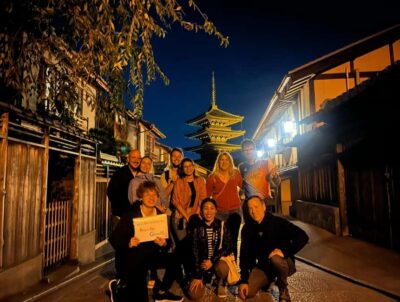
Gion Magical Night Walking Tour with Geisha Trivia
Read our review →
Gion Geisha District Walking Tour – Stories of Geisha
Read our review →
Kyoto Gion Geisha District Walking Tour – The Stories of Geisha
Read our review →
Nishiki Market Brunch Walking Tour (7 Tastings + Brunch)
Read our review →
Kyoto Arashiyama Walking Tour: Bamboo, Monkeys, Gardens & Secrets
Read our review →
Kyoto Gion: 2-Hour Geisha Culture & History Walking Tour
Read our review →Also filed under