
Reviewed · WALKING TOURS
One-Day Walking Tour : Enjoy Kyoto to the fullest!
Kyoto hits different before the crowds. This one-day walking route takes you through Kyoto’s signature scenes with a guide who adds context while you move, not just when you stop. You start at Kyoto Station, then wind your way across the city from bamboo to temples to torii gates, finishing back where you began.
I love the early bamboo-forest timing because the light feels softer and the place is easier to take in. I also love the guide-led navigation through transit, especially when buses and trains are packed or confusing. The day is built so you spend time seeing Kyoto, not constantly figuring out the next train.
One heads-up: it is a long day of walking (about 8 hours) and Kinkaku-ji has an admission fee not included. If you get heat-sick or your knees complain, plan carefully and pace yourself.
In This Review
- Key highlights at a glance
- A tight 8-hour Kyoto route that still feels like a day
- Kyoto Station at 9:00 am, then off across town
- Stop 1: Bamboo Forest Street in the morning light
- Stop 2: Kinkaku-ji Golden Pavilion, tickets and timing reality
- Stop 3: Gion for possible geisha sightings and real street mood
- Stop 4: Fushimi Inari-taisha, torii gates and how to enjoy the “tunnel” feel
- Price and value: what you are really paying for
- Getting around Kyoto without losing your day
- Comfort on a walking day: shoes, shade, and hydration
- What you might not love as much
- Who should book this tour?
- Should you book this Kyoto highlights walking tour?
- FAQ
- What places are included in the one-day walking tour?
- How long is the tour?
- Where do I meet the guide?
- What time does the tour start?
- Is the Kinkaku-ji admission fee included?
- Are there admission fees for the other stops?
- What about transportation and meals?
- Is this a private tour or a group tour?
- Is there walking involved, and is it suitable for everyone?
- What is the cancellation policy?
Key highlights at a glance
- Morning bamboo before it gets busy: A calm start in Arashiyama Bamboo Grove, with time to actually look around.
- Kinkaku-ji Golden Pavilion with the entry cost in mind: Stunning gold-leaf views, plus a separate ticket you should budget for.
- A Gion walk where geisha might appear: You’re in the right neighborhood for a real Kyoto street moment.
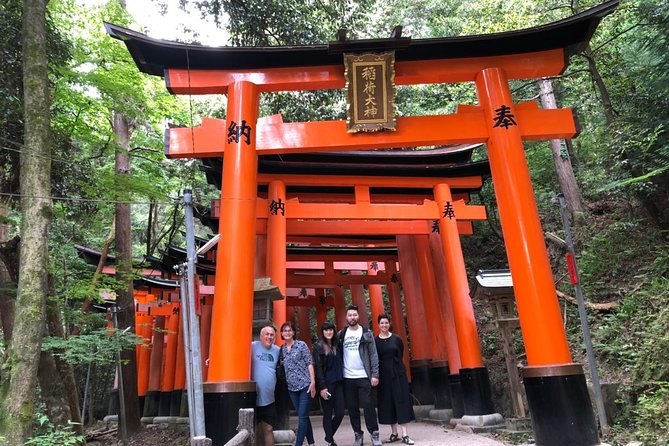
- Fushimi Inari’s torii-gate tunnel: A classic photo-and-walk experience with generous time on site.
- Private guiding that helps you move smart: Many guides are praised for keeping people on track without rushing.
A tight 8-hour Kyoto route that still feels like a day
This tour is designed for people who want Kyoto’s big hits without turning the trip into a logistics contest. You get one guided day covering Arashiyama Bamboo Grove, Kinkaku-ji, Gion, and Fushimi Inari-taisha. It is efficient, but it is not a cookie-cutter bus loop.
The flow matters. You start early, you hit Kinkaku-ji at a reasonable hour, and you end at Fushimi Inari while you still have energy to enjoy the long, repetitive beauty of the torii gates. Most importantly, you do not have to spend your day reading maps and guessing which train or bus will actually work.
This is also a private tour for your group, so the pace can match your needs more than a large group tour can. If you have someone who needs extra time for photos, shade breaks, or just a slower rhythm, a good guide can absorb that.
Kyoto Station at 9:00 am, then off across town
The meeting point is Kyoto Station Building (901 Higashishiokōjichō, Shimogyo Ward). The start time is 9:00 am, and the tour ends back at the meeting point. That round-trip design is a small thing, but it keeps you from having to re-plan your day around a different drop-off location.
Budget-wise, you should think about transit costs up front. The guide fare is included, but public transportation is not (listed as ¥1,500 per person). In reality, you will rely on trains and buses throughout the day, and that is exactly where the guide’s job gets practical. Several guides are specifically praised for helping people navigate the transit system, so you’re not guessing which station exit or transfer step matters.
A quieter way to spend a day in Kyoto
- Kyoto Geisha Walking Tour: Gion District & Hidden Gems
★ 4.7 · 3,273 reviews - Kyoto: Gion Magical Night Walking Tour with Geisha Trivia
★ 4.9 · 2,393 reviews - Kyoto: Gion Geisha District Walking Tour – Stories of Geisha
★ 4.7 · 2,187 reviews - Night Walk in Gion: Kyoto’s Geisha District
★ 4.5 · 2,003 reviews
Stop 1: Bamboo Forest Street in the morning light
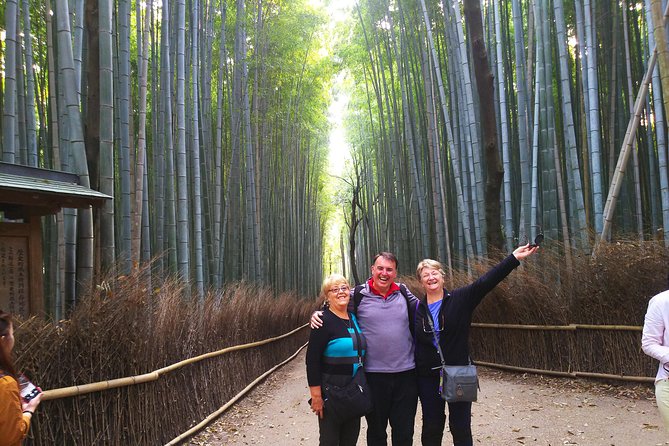
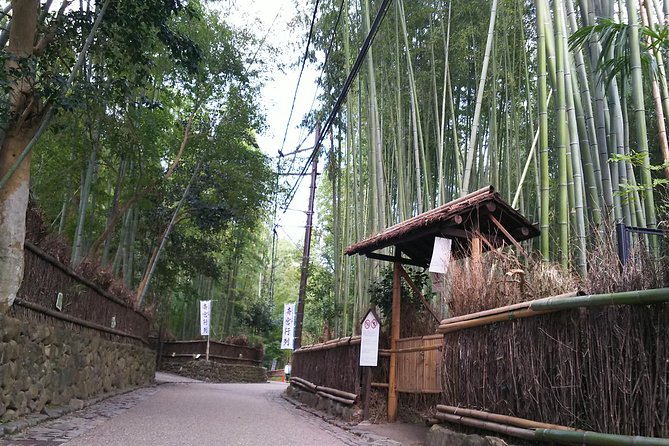
You start with Bamboo Forest Street in the Arashiyama area, about 1 hour with admission ticket free. The key is the timing. Early morning means softer light and less crowd pressure, so you can slow down and actually notice the textures and the way the breeze moves through the stalks.
I like this stop because it gives you a mental reset. You walk through something instantly recognizable, but the experience is not just about photos. The bamboo grove tends to feel calm when you arrive before the peak waves, and that makes it a strong opener for a day that later includes busy shrine streets and major temple grounds.
A practical tip: bamboo areas can still feel hot and humid in summer, even early. Bring a light layer you can stand to carry, and if you’re a fast walker, keep your pace easy here. You want time to stop, look, and let the place do its work.
Stop 2: Kinkaku-ji Golden Pavilion, tickets and timing reality
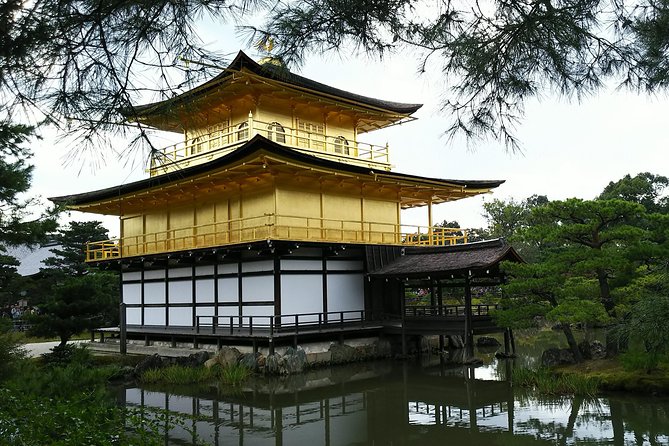
Next up is Kinkakuji Temple (Golden Pavilion) for about 1 hour. This is the big-ticket moment of the day, and it matters that admission is not included. The listed fee is ¥500 per person.
Kinkaku-ji’s appeal is simple: it is visually loud in the best way. The main building is covered with gold leaf, and that shine changes depending on the sky and reflections in the surrounding water features. It is one of those Kyoto sights where, even if you have seen pictures, you will understand why people care once you stand close.
Here’s the practical consideration: because the ticket is extra, you should keep a little cash or plan your payment in advance. Also, Kinkaku-ji can attract crowds, so the guide’s pacing is important. A good guide helps you move at the right speed and avoids the most frustrating congestion without making you feel rushed.
If you care about the history angle, the best guides turn this stop from a photo stop into a story stop. Some guides highlight the fact that Kinkaku-ji was originally a villa of a retired shogun and later became a temple after his death. That context makes the architecture feel less like decoration and more like legacy.
Stop 3: Gion for possible geisha sightings and real street mood
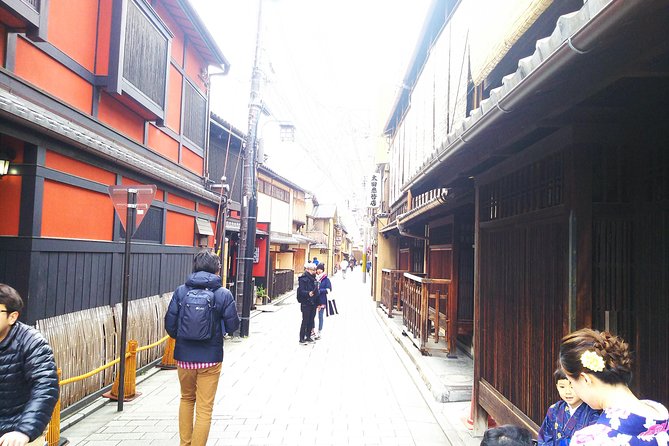
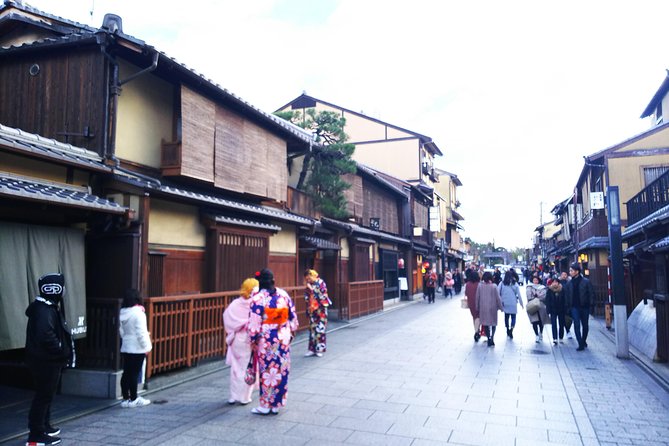
Then you head into Gion, roughly 40 minutes, with admission ticket free. This is the neighborhood that most people associate with Kyoto’s traditional image, and it’s also where the day gets more street-level.
The tour framing here is smart: you do not try to force a formal performance. Instead, you take a short walk through the area where geisha might be seen on their way between boarding houses and tea houses. That means your experience is partly about noticing, not just arriving at one landmark.
I also like that this stop adds variety. After bamboo and a major temple, Gion gives you a different kind of Kyoto. The streets feel slower, and the atmosphere is more about daily life and old-world architecture than a single ticketed attraction.
One caution: 40 minutes is not a long time. If you want deeper wandering in Gion, treat this as your taste test. Use your guide time for orientation, then decide what you want to explore on your own during your remaining hours in Kyoto.
Stop 4: Fushimi Inari-taisha, torii gates and how to enjoy the “tunnel” feel
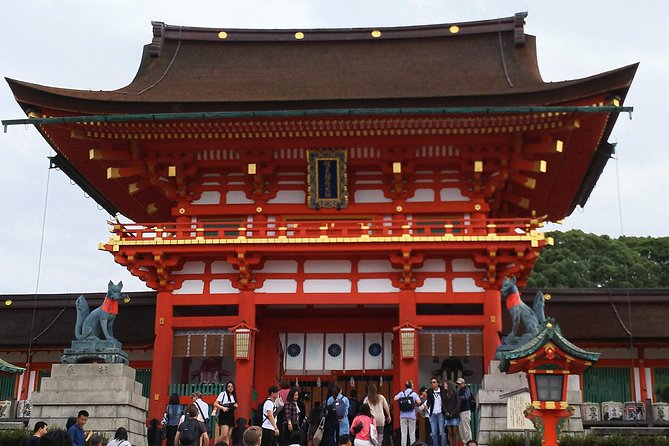
Finally, you reach Fushimi Inari-taisha Shrine for about 1 hour, also free to enter. The headline is the tunnel of thousands of vermillion torii gates. It is famous for a reason, but what surprised me in other Kyoto shrine experiences is how the colors and repetition start to feel rhythmic rather than overwhelming.
This stop is where the day’s pacing matters most. One hour is enough to get the torii-gate experience and still move at a comfortable walking speed. If you push too hard, you miss the calming effect that makes Fushimi Inari different from a normal sightseeing stop.
Guides usually help you walk the right paths and avoid time-wasting detours. That matters because the shrine grounds can turn into a choose-your-own-route maze quickly. If you’re the type who likes to understand where you are and why, a guide can help you interpret what you’re seeing without turning it into a lecture.
Photo lovers should prepare for steps. Even when you do not climb aggressively, the gate sequences encourage you to walk forward and backward to compare angles. Wear shoes you can stand in for a while.
A day of temples goes further with something to break it up.

Price and value: what you are really paying for
The price is listed at $131.14 per person for approximately 8 hours. On paper, it sounds like a lot for four stops. In practice, a large portion of the value is in the guide and the way the day is structured.
You get guide fare included, while major costs stay separate:
- Kinkaku-ji admission: ¥500 per person (not included)
- Public transportation: ¥1,500 per person (not included)
- Meals: not included
That breakdown changes how you should judge value. You are paying for someone to:
1) lead the route across Kyoto,
2) help you handle transit without stress,
3) provide context that makes each site more meaningful than a checklist.
In the feedback, guides like Hironori, Seiya, Noriko, Toshi, Fuji, Koichi, Naoko, Saori, and Leo get praised for pacing, explanations, and helping people navigate. That’s the “why” behind the price. You are not just buying access to Kinkaku-ji and Fushimi Inari. You are buying a full-day plan that keeps the day moving.
Also, many people highlight that the day can be adjusted a bit for real group needs, like families. That flexibility is hard to replicate if you are self-guiding with only a map app.
Getting around Kyoto without losing your day
Kyoto’s transit system is workable, but it can feel like a puzzle when you’re hot, tired, and checking signs in another language. This is where the tour pays off in a very practical way.
You use public transportation, and the tour is timed across multiple neighborhoods. Several guides are singled out for helping people traverse the train and bus system smoothly. That usually means two things:
- You get clear meeting points for transfers.
- You avoid wasting time at the wrong station exit or on an ineffective route.
Even if you are comfortable navigating on your own, having a guide reduces the mental load. And when you reduce mental load, you actually have energy left to enjoy bamboo, gold leaf, and the torii tunnel instead of just surviving the commute.
Comfort on a walking day: shoes, shade, and hydration
The tour states moderate physical fitness is required and that it involves quite a bit of walking. One big theme from feedback is heat management. People mention hot weather days, and guides are praised for keeping hydration going and finding shade when possible.
So plan like it’s going to be a workout. Bring:
- comfortable walking shoes with grip,
- a small water bottle or a plan to buy water,
- sunscreen and a light hat if you’re sensitive to sun.
If you rely on public transit plus a lot of walking, start the day fresh. Eat something before you meet at 9:00 am, because you still have a long stretch ahead before meal options return later in the day.
And if you’re traveling with kids or someone in a stroller or pram, this tour can still work, but the key is communication. Some guides are praised for being patient and accommodating with different group needs, so bring that up early.
What you might not love as much
This tour hits four top-tier Kyoto stops, but you are trading depth for coverage. That means:
- you will not have hours and hours in any single place,
- you might want more time wandering beyond the route.
Also, because Kinkaku-ji has a separate ticket and transit has a separate estimated cost, you should budget extras. If you’re trying to keep the day ultra-cheap, this is not the right style of tour.
Finally, because the day is built on walking, it can be tough if you dislike crowds or if your stamina is limited. The itinerary is designed for you to keep moving.
Who should book this tour?
This is a great match if you:
- want Kyoto highlights in one day without creating a DIY routing headache,
- enjoy guided explanations that make icons feel understandable,
- like morning starts and are okay with a full day on your feet.
It also suits group travelers who want a private format. The private nature can help with pace and small adjustments, which is especially helpful for families.
You might want to skip it if you:
- want slow, deep temple time with lots of downtime,
- hate walking and prefer car-based touring,
- need a highly flexible schedule that changes constantly.
Should you book this Kyoto highlights walking tour?
If you want an efficient, meaningful sampler of Kyoto, this tour is easy to recommend. The route hits the bamboo morning moment, the Golden Pavilion icon, the Gion street vibe, and the torii tunnel at Fushimi Inari in one coherent day. The strongest value is the human part: guides help you stay on track, interpret what you’re seeing, and handle transit stress.
I’d book it when you have limited time in Kyoto and you want the big visual hits done right. I’d skip or reconsider if your plan is to take it slow, or if you expect to spend most of the day sitting and hopping between spots with minimal walking.
If you do book, go in with the right mindset. Wear good shoes, bring water, and treat the day as one long Kyoto conversation, not four separate photo stops. That approach makes the walking feel like part of the charm instead of the price.
FAQ
What places are included in the one-day walking tour?
The tour includes Bamboo Forest Street, Kinkaku-ji Temple, Gion, and Fushimi Inari-taisha Shrine.
How long is the tour?
It runs for about 8 hours.
Where do I meet the guide?
You meet at Kyoto Station Building, 901 Higashishiokōjichō, Shimogyo Ward, Kyoto 600-8216, Japan.
What time does the tour start?
The start time is 9:00 am.
Is the Kinkaku-ji admission fee included?
No. Admission for Kinkakuji is not included, and the listed fee is ¥500 per person.
Are there admission fees for the other stops?
The tour information lists admission ticket free for Bamboo Forest Street, Gion, and Fushimi Inari-taisha Shrine.
What about transportation and meals?
Public transportation fare is not included (¥1,500 per person listed). Meals are also not included.
Is this a private tour or a group tour?
It is described as private, meaning only your group participates.
Is there walking involved, and is it suitable for everyone?
The tour requires moderate physical fitness and says there is quite a bit of walking.
What is the cancellation policy?
Free cancellation is available up to 24 hours in advance for a full refund. If you cancel less than 24 hours before the start time, the amount paid is not refunded. The experience requires good weather, and if canceled due to poor weather, you will be offered a different date or a full refund.
New This Season
- Koyasan Day Trip by Private Car from Kyoto
- Old Port Town and Ultimate Sake Tasting Private Tour From Kyoto
- Kyoto’s Timeless Charm: 3hr Exploration of History and Peace
- Kyoto: 5 Types of Sushi Making
- Sacred Peak & Ancient Paths: Kurama-Kibune Hiking Experience
- Kyoto: Exclusive ZEN practice at Manpukuji temple in Uji
- Traversing Kyoto’s Scenic West – Arashiyama to Kinkakuji
- Kyoto: Private Seasonal Aroma Yoga Class
Walking Tours, compared.
Kyoto Geisha Walking Tour: Gion District & Hidden Gems
Read our review →
Gion Magical Night Walking Tour with Geisha Trivia
Read our review →
Gion Geisha District Walking Tour – Stories of Geisha
Read our review →
Kyoto Gion Geisha District Walking Tour – The Stories of Geisha
Read our review →
Nishiki Market Brunch Walking Tour (7 Tastings + Brunch)
Read our review →
Kyoto Arashiyama Walking Tour: Bamboo, Monkeys, Gardens & Secrets
Read our review →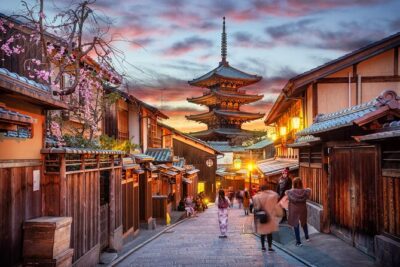
Kyoto Gion: 2-Hour Geisha Culture & History Walking Tour
Read our review →Also filed under