
Reviewed · ARTISAN CRAFT WORKSHOPS
Authentic knife making experience at a blacksmith in Kyoto
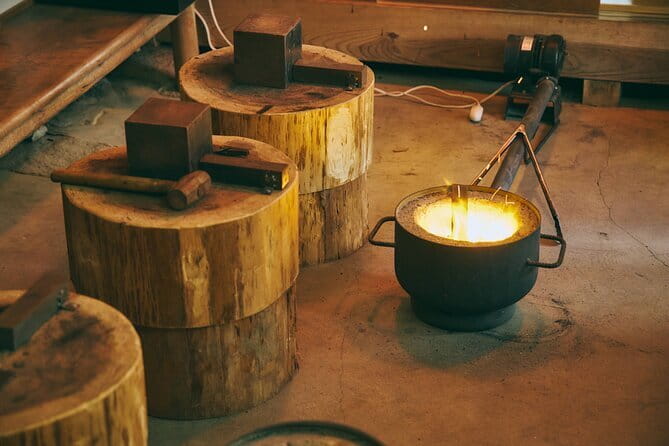
Hitting red-hot steel is strangely addictive. This Kyoto workshop lets you make a practical, real Japanese-style knife and take it home, not just pose for photos. You’ll do the full arc, from safety briefing and heating steel to forging, sharpening, and polishing in a hands-on studio setting just outside central Kyoto.
I like that you get a genuinely usable souvenir, about 13 to 15 cm long, with a box and bag for the ride home. A big plus is the mix of structure and patience from instructors like Mao, and sometimes staff such as Taka, Daiki, Mits, and Atsushi depending on the day. The only drawback to plan for is that this is physical and heat-heavy work, so you need to be ready to hammer, work near hot tools, and follow safety rules closely.
In This Review
- Key Points You Should Know Before You Go
- Kyoto Knife Making That Actually Ends With a Knife in Your Hands
- Where It Happens in Kyoto, and Why the Station Walk Matters
- Before You Forge: Attire, Tools, and Safety with Mao and the Team
- From Red Hot Steel to Your Blade: The Forging Steps
- Cooling, Refining, and the Part That Turns Effort Into Quality
- Sharpening Stones, Grinders, and Bringing the Edge to Life
- Polishing, Final Finish, and What You’ll Take Home
- Practical Value and Price: Is $154 Worth It?
- Who This Knife Workshop Suits (and Who Might Want to Think Twice)
- Extra Touches That Make the Day Feel Like a Real Workshop
- Should You Book This Kyoto Knife Forging Experience?
- FAQ
- How long is the Kyoto knife making experience?
- What will I take home at the end?
- How much does it cost?
- What should I bring?
- Is the workshop for kids?
- Do I need to know Japanese?
- Is alcohol allowed during the workshop?
- Do they offer knife making at different studios in Kyoto?
Key Points You Should Know Before You Go
A handmade knife you can actually use
You’ll finish with a blade designed for everyday kitchen life, not a decorative keepsake.
Foraging-level rarity, right here in Kyoto
Blacksmithing is uncommon as a visitor experience, even in Japan, so this feels special fast.
A clear, step-by-step workflow
You’re guided from furnace heat to shaping to sharpening, so beginners still end up with a functioning knife.
Small group coaching
Classes are kept small, which means more hands-on guidance when your angles or timing are off.
Location near a station exit
It’s a very short walk from the Eizan Electric Railway Yase-Hieizan Exit, but give yourself buffer time and confirm which Sakyo-ku studio you’re attending.
Kyoto Knife Making That Actually Ends With a Knife in Your Hands
If you’ve done Japan’s classic stuff like temples and markets, this is a different kind of cultural hit. Knife making is craft, muscle, concentration, and patience all at once. And the best part is simple: you leave with the object you created.
This workshop is built around a full traditional sequence. You start with raw steel, you heat it until it glows, you hammer it into a knife shape, and you finish with sharpening and polishing so it is ready to use or gift. If you want a memory with weight, this beats another souvenir keychain every time.
The English support is solid too, with instruction in English and Japanese. So even if your Japanese is basic, you still get the steps in a way you can follow without guessing.
Where It Happens in Kyoto, and Why the Station Walk Matters
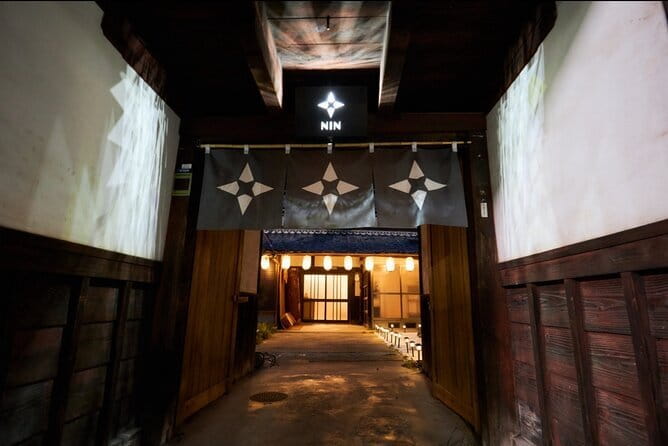
The studios are in Sakyo-ku, and your exact workshop location can be either Studio NIN Yase or Studio NIN Kendo. Before you go, the staff will message you to confirm which studio to attend. Your provided meeting point is Studio Shinobi YASE at 168-1 Yase-no-secho, Sakyo-ku, Kyoto.
Here’s the practical takeaway: use the train if you can. The walk is listed as about a minute from the Yase-Hieizan Exit of the Eizan Electric Railway. That’s close enough to make the day feel easy, even if you’re juggling other Kyoto plans.
One more thing I’d plan for: it’s easy to waste time if navigation sends you to the wrong studio or route. I’d give yourself extra buffer on arrival, especially if it’s your first day in Kyoto or you’re switching between maps and transit directions.
Make something with a Kyoto craftsman
- Kyoto: Calligraphy class at Buddhist temple in city center
★ 5.0 · 167 reviews - Roketsu dyeing experience: M course Roketsu Dyeing Experience
★ 5.0 · 163 reviews - Kyoto: Japanese Calligraphy Class
★ 4.8 · 89 reviews - Kyoto: Japanese Calligraphy Workshop
★ 4.7 · 84 reviews
Before You Forge: Attire, Tools, and Safety with Mao and the Team
Check-in is straightforward. You arrive at the studio and you meet your instructor, Mao, who has over 10 years of knife professional experience. Depending on the day, you may also be guided by other team members, and you may hear different teaching styles from instructors such as Taka, Daiki, Mits, and Atsushi.
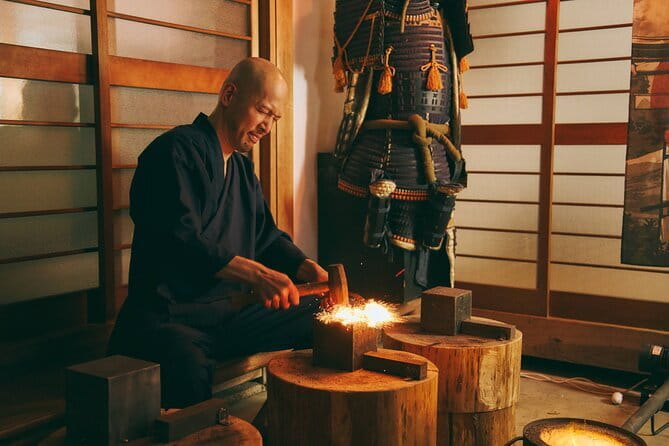
Then you get dressed. You change into traditional blacksmith attire, the kind of craftsman uniform Japanese smiths wear. It sounds small, but it really does change the vibe. You stop thinking of this as an activity and start thinking of it as work in a real shop environment.
Next comes tools and safety. You’ll learn how to handle the key equipment like hammers and tongs, plus how grinders and sharpening stones fit into the workflow. Expect clear instruction, not a vague “try it and hope” setup.
Safety matters here because you are working near 800 to 900°C heated metal, and some sessions include physical tasks close to hot surfaces and tools. The rules are also explicit: alcohol and drugs are not allowed. You’ll also be asked to bring socks, which is practical because your feet matter when you’re standing, moving, and working close to equipment.
One personal practical tip that shows up in multiple ways: stretch a little before you arrive. Hammering asks your wrists, forearms, shoulders, and core to stay awake for a while.
From Red Hot Steel to Your Blade: The Forging Steps
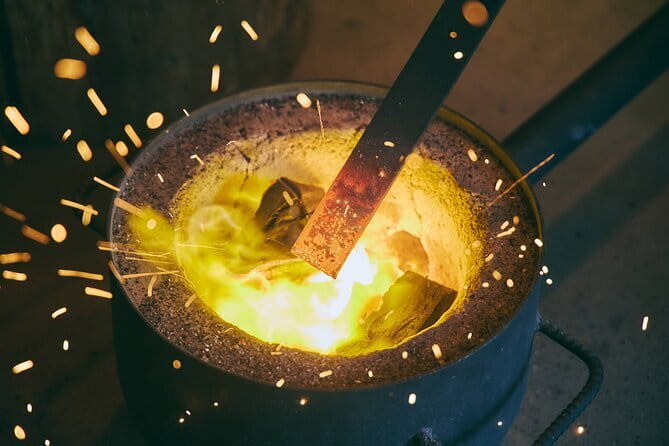
This is the heart of the experience, and it’s where the workshop earns its reputation.
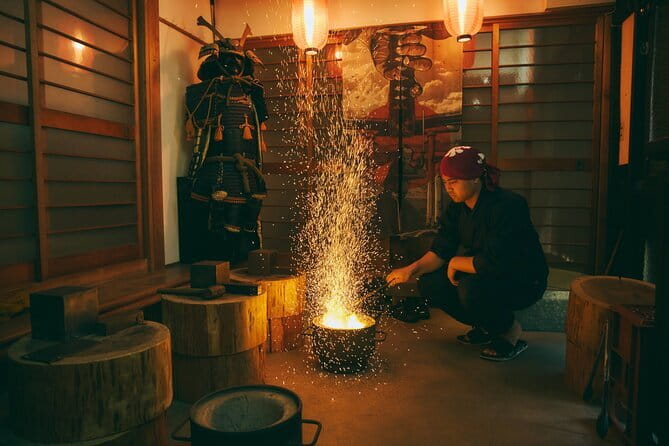
The steel goes into the furnace and heats until it’s red-hot. That moment is more dramatic than you’d expect, especially if you’re used to kitchens being calm and cool. But it’s also the start of the craft logic: metal behaves differently at heat, and the forging steps depend on timing and control.
When you forge the blade, you’ll strike the glowing steel repeatedly with a hammer. Mao or your instructor will show you the correct hammering angle and rhythm, and they stay close so you keep control and stay safe. The hammer work is not “random pounding.” It’s guided shaping.
This is also where you learn a basic truth about making things. Even with instruction, your first attempts might feel clumsy. But the team helps you correct grip, angle, and pace so you experience true forging rather than just swinging metal around.
A detail worth knowing: your session is designed as a refined format. The workshop duration is listed as 3 hours, and the process is described as a refined 2.5-hour format for making. Either way, you’re not stuck doing endless steps. It’s built to deliver a full result without turning the day into a marathon.
During the session, photos and videos are welcome throughout. That’s great because you’ll want proof of the furnace moment and the forging stages, not just the final knife.
Cooling, Refining, and the Part That Turns Effort Into Quality
After forging, the metal gets cooled and checked for shape. This is less glamorous than the furnace, but it’s crucial. If the blade geometry isn’t right, sharpening later can only do so much.
You’ll refine rough edges and prepare the blade for the next stages. This part is where beginners often feel the most progress. Your knife starts looking like a knife rather than a lump you hammered.
This phase also gives you a chance to slow down. Forging is big movement. Refining is careful handling. That contrast is part of why the experience feels “real” instead of rushed.
And it’s where you start appreciating why Japanese kitchen knives are respected. A usable edge is not just luck or magic. It comes from getting shape right before you chase the edge.
Sharpening Stones, Grinders, and Bringing the Edge to Life
Sharpening is one of the most rewarding parts, because you can literally see the edge come alive. Under expert instruction, you’ll use sharpening stones and grinders to shape a functional cutting edge.
Even if you’ve never held a whetstone before, the team guides you through the process so you learn what to do and why. You’re not just copying motions. You’re learning how edge geometry changes with pressure and angle.
The sharpening stage also changes how you think about your knife’s purpose. At this point, it’s no longer a souvenir. It’s a tool that will matter when you get home.
If you’re someone who likes hands-on craft, you’ll likely feel a small pride spike when you start getting consistent strokes and a clean edge line.
A day of temples goes further with something to break it up.


Polishing, Final Finish, and What You’ll Take Home
Once shaping and sharpening are done, you polish the blade to a clean finish. This step transforms raw forged steel into something you’d feel comfortable gifting or using.
About the final product: your finished knife is about 13 to 15 cm long, and it’s fully handmade. You’ll get it ready to take home, with a box and a bag included. That packaging is more useful than it sounds, because it protects the blade during transit and storage.
One finishing note from within the teaching style: some knives are finished in a Kurouchi-style rustic look, which is part of the aesthetic and also helps with anti-rust. So if you’re picturing a mirror-shiny “knife showroom” surface, temper expectations. The charm is often in the handcrafted look, not the sterile polish.
Also, don’t expect perfection. You’re making a real tool through a beginner-friendly process. The instructors aim for a blade you can be proud of and actually use.
Practical Value and Price: Is $154 Worth It?
At $154 per person for around a 3-hour class, the value is mostly in three things: you make something you can use, the instruction is hands-on, and the materials and tools are handled for you.
You’re not paying for a ticket to watch someone else work. You’re paying for guided access to a craft that most people never try. Blacksmithing is rare as a visitor experience, even in a country full of craft studios.
The workshop includes the costume, towel, water, tools, materials, plus the final box and bag. That reduces the hidden costs you’d normally have to cover with a DIY class, like safety gear and consumables. And you end with a real, personal object that becomes part of your home routine.
There’s also a subtle value angle that shows up in how people talk about this kind of activity. Even if your knife isn’t identical to a pro-made one, you gain the “I did this” confidence. That’s why many people treat it as a lasting memory, not just a one-off experience.
If you’re comparing it to other Kyoto workshops, this tends to feel more memorable because your work is physically demanding and your result is tangible.
Who This Knife Workshop Suits (and Who Might Want to Think Twice)
This is a strong fit for people who like learning by doing. If you enjoy cooking, you’ll love how it feels to make something that matches what you do at home. If you enjoy hands-on crafts, this is a natural match.
It’s also ideal for small groups. The class is described as small group available, and the payoff is more personal coaching while you hammer, refine, and sharpen.
Age-wise, it’s not suitable for children under 15 unless they are with a guardian. It also isn’t suitable for people over 95 years. The reason is straightforward: it’s physically active and involves tools and hot materials.
One more practical note: some parts of the experience can be a bit challenging. You are working with heated metal and working through sequences that require focus. So if you want a fully relaxed, sit-and-watch activity, this probably won’t be your style.
Extra Touches That Make the Day Feel Like a Real Workshop
A knife class can be just tools and heat. This one tries to feel like a small studio day.
Photos and videos are welcome throughout. So you can capture the “in the middle of making” moments, not only the end result.
There are also occasional small add-ons described by participants. For example, some sessions include shuriken casting while you wait. And there may be food and drink at the end, such as plum wine and sausages, depending on what’s available that day.
Even little comforts can matter in a hot metal workshop. One mention was that frozen neck coolers and air conditioning can be used to make heat more tolerable. If you’re visiting in warmer months, that kind of support is not a luxury.
Should You Book This Kyoto Knife Forging Experience?
Book it if you want a Kyoto activity that ends with a real tool, not just a photo. This is one of those rare experiences where the craft is the product, and you get guided access to every step that makes a functioning Japanese-style kitchen knife.
Skip or reconsider if you hate physical work, feel uncomfortable around hot equipment, or you’re looking for a low-effort, fully relaxed afternoon. Also, if your must-have souvenir is a perfectly polished showroom finish, you might prefer a different style, since the charm can be in rustic forged looks like Kurouchi.
If you’re planning your first Kyoto “hands-on” day, this is a strong candidate. It’s accessible by train, it’s structured like an actual workshop, and it gives you something you can use at home, which is the best kind of travel purchase.
FAQ
How long is the Kyoto knife making experience?
The workshop runs about 3 hours, based on the session duration listed.
What will I take home at the end?
You’ll take home the knife you make. It is about 13 to 15 cm long and is ready to take home in a box and bag.
How much does it cost?
The price is listed as $154 per person.
What should I bring?
Bring socks. Water is provided, and you’ll be given a towel.
Is the workshop for kids?
Children under 15 must be accompanied by a guardian. The activity is not suitable for children under 15, so plan accordingly.
Do I need to know Japanese?
No. The instructor team provides instruction in English and Japanese.
Is alcohol allowed during the workshop?
Alcohol and drugs are not allowed.
Do they offer knife making at different studios in Kyoto?
Yes. The workshops operate out of two studios in Sakyo-ku, Kyoto, and staff will message you before your visit to confirm whether you should attend Studio NIN Yase or Studio NIN Kendo.
New This Season
- Koyasan Day Trip by Private Car from Kyoto
- Old Port Town and Ultimate Sake Tasting Private Tour From Kyoto
- Kyoto’s Timeless Charm: 3hr Exploration of History and Peace
- Kyoto: 5 Types of Sushi Making
- Sacred Peak & Ancient Paths: Kurama-Kibune Hiking Experience
- Kyoto: Exclusive ZEN practice at Manpukuji temple in Uji
- Kyoto: Private Seasonal Aroma Yoga Class
- Traversing Kyoto’s Scenic West – Arashiyama to Kinkakuji
Artisan Craft Workshops, compared.
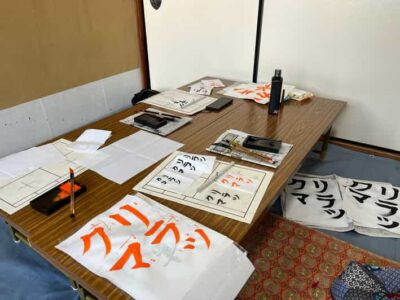
Calligraphy class at Buddhist temple in city center
Read our review →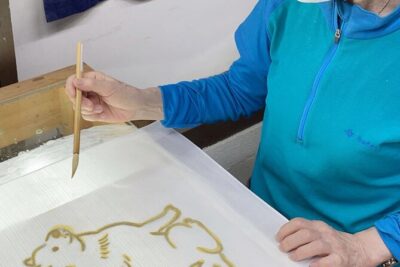
Roketsu dyeing experience: M course Roketsu Dyeing Experience
Read our review →

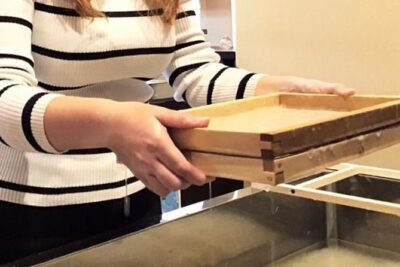
Traditional Japanese Washi Papermaking- Kyoto morning
Read our review →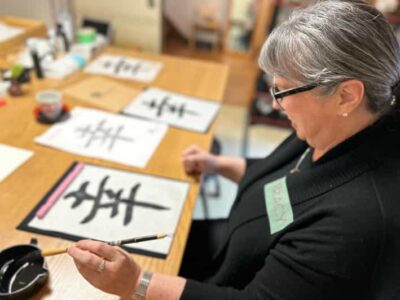
Also filed under