Reviewed · FUSHIMI INARI SHRINE WALKS
Fushimi Inari Shrine: Explore the 1,000 Torii Gates on an audio walking tour
A thousand red gates, one calm stroll. This self-guided VoiceMap audio tour helps you read Fushimi Inari beyond postcards, with offline access and ritual stories built into each stop.
You get an easy walk through the fox-studded shrine grounds, plus a guided path that helps you spot what people rush past.
I especially like the at-your-own-pace format. You can pause, take photos, and re-join the route without feeling herded.
One catch to plan for: you must bring your smartphone and headphones, and download the tour content in advance, or the experience will stall once you are at the shrine.
In This Review
- Key highlights you will feel on the walk
- Fushimi Inari by audio: why it works so well here
- Price and what you get for $5.99
- Timing: a 45 to 60 minute plan that still feels complete
- Where you start: the fox statue across from Inari Station
- Stop by stop: how the audio tour guides your attention
- The shrine context: before you enter the famous gates
- Hand Water: the ritual moment that resets the visit
- The main hall break: a short pause for the big moment
- Wabisabi: learning how to notice what time does
- Senbon Torii: walking the 1,000 gates without losing your place
- Heavy-Light Stone, Okusha, and the root-up pine tree
- The Heavy-Light Stone wish stop
- Okusha shrine: going farther than the postcard view
- Root up Pine Tree: a quick stop with meaning
- Ending at Kumataka Shrine: the calm pond finish
- Practical tips so the tour feels effortless
- Who this VoiceMap Fushimi Inari tour suits best
- Should you book? My decision guide
- FAQ
- How much does this Fushimi Inari audio tour cost?
- How long is the tour?
- Is the audio tour in English?
- Does the tour work offline?
- Where is the meeting point?
- Where does the tour end?
- What do I need to bring?
- Is this a group tour with other people?
- What are the opening hours?
Key highlights you will feel on the walk

- Offline-first VoiceMap: audio, maps, and geodata available even without cell service
- Start at the fox statue near Inari Station: you begin with context, not a random scramble
- Hand Water and a pause at the main hall: the route gives you built-in moments to reset
- Senbon Torii progression: walk the famous 1,000 gates with an audio rhythm that keeps you oriented
- Landmarks that are easy to miss: you are pointed to the Heavy-Light Stone and other specific spots
- Quiet finish near Kumataka Shrine pond: a softer ending than you might expect at such a popular site
Fushimi Inari by audio: why it works so well here
Fushimi Inari Taisha is the kind of place where everyone photographs the red gates. But if you only look outward, you miss why people keep coming back for generations. This audio walking tour turns the shrine into a story you can follow step by step.
The big win is structure. Each segment nudges you to notice something specific, like the fox statues, the rituals practiced at shrines, or how the path through the torii gates is meant to be walked. Instead of wandering, you get a gentle “keep going, look here” feeling.
And because it is self-guided, you can move at a human pace. I like that the route is short enough that you do not burn your whole day, yet long enough to feel like you actually went somewhere inside the shrine grounds.
Price and what you get for $5.99
At $5.99 per person, this tour is priced like a small upgrade, not a big tour-group splurge. You are essentially paying for a reusable audio guide plus offline map support.
What you get:
- Lifetime access to the tour in English
- The VoiceMap app on Android and iOS
- Offline access to audio, maps, and geodata
What you do not get:
- No transportation included
- No food or drink included
- No museum-style ticketed stops included
- You supply your own smartphone and headphones
That value math works well if you like independence. If you hate apps, or you want someone physically guiding you at each turn, you may prefer a live tour. But if you can handle a phone and earbuds for under an hour, this is a good deal.
One more thing to keep in mind: this experience is non-refundable and cannot be changed. So make sure your plans are firm before you buy.
Still climbing through the orange gates?
- Kyoto: Fushimi Inari, Kinkakuji, Bamboo Grove 1 Day Bus Tour
★ 4.8 · 4,316 reviews - Fushimi Inari Hidden Hiking Tour (Private Option Available)
★ 5.0 · 1,750 reviews - Osaka/Kyoto:Kinkakuji,Arashiyama,FushimiInariShrine,NaraPark
★ 4.1 · 1,596 reviews - Kyoto/Osaka: Nara, Fushimi Inari Taisha, Arashiyama Bus Tour
★ 4.7 · 1,275 reviews
Timing: a 45 to 60 minute plan that still feels complete
The tour runs about 45 minutes to 1 hour. That matters at Fushimi Inari because it is extremely popular. Thousands of people visit every day, so having a focused route helps you avoid the “I was here, but I do not know what I saw” problem.
Also, the walk is described as an easy stroll among tranquil forest scenery. In practice, that means you should expect a lot of steps and moving through corridors of gates, but it is not built like a long hike. It is a compact shrine visit with a clear beginning and ending.
Where you start: the fox statue across from Inari Station
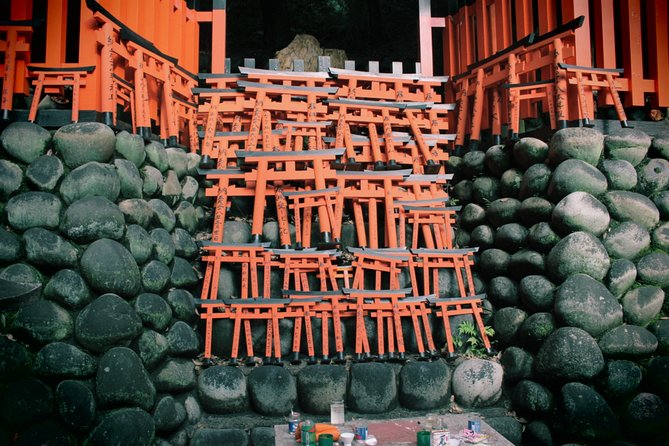
You begin at the entrance to Fushimi Inari Taisha Shrine, opposite Inari station, in front of a fox statue. That is smart for two reasons.
First, the location is easy to find. Second, you start with an image that sets the theme. The fox statues show up across the shrine complex, and the audio uses that as an anchor so you can connect what you are seeing to what you are hearing.
Practical tip: once you reach the area, take a few seconds to confirm you have the correct start point in the app. The shrine grounds are close together, but getting your bearings early makes the rest of the route feel smooth.
Stop by stop: how the audio tour guides your attention

The shrine context: before you enter the famous gates
Right after the start, the audio covers significance related to the shrine. This is the part that makes the later torii gates hit harder.
Without context, Senbon Torii can feel like a beautiful photo wall. With context, it feels like a guided approach to a religious space. Even if you do not know Japanese ritual language, you will pick up the meaning behind what people do here.
If you tend to skip intro explanations on tours, do not on this one. This early orientation pays off when the gate corridor starts to stretch ahead of you.
More rooftops worth a detour




Hand Water: the ritual moment that resets the visit
Next comes a stop where you learn about Hand Water. Even if you are not a ritual-focused visitor, this matters because it slows you down in the right way.
You are not just moving from one viewpoint to another. You are stepping into how shrine visitors behave and why. That changes your mindset from sightseeing mode to observing mode, and the whole place feels more intentional.
A small consideration: because the route is self-guided, you control your pace. That is great, but it also means you should plan a quiet moment for yourself here, instead of rushing through it while trying to beat crowds.
The main hall break: a short pause for the big moment
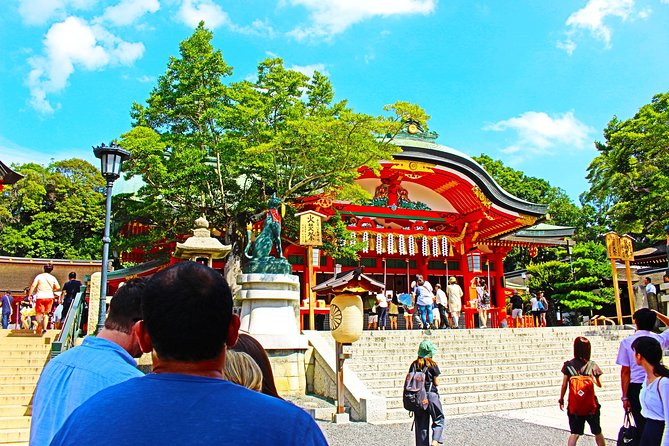
You then get a short stop at the main hall. The tour does not try to turn this into a marathon. It gives you a brief moment to register the most important architecture and the feeling of the shrine space before you head deeper into the torii corridor.
This is also where you can catch your breath. Fushimi Inari is popular, so expect people around you. The audio helps you keep your eyes moving with purpose instead of just staring at every distraction.
Wabisabi: learning how to notice what time does
After the main hall, the audio shifts to Wabisabi. Here is the practical value: it gives you a lens for seeing the place, not just a list of facts.
You start paying attention to the way materials look older, weathered, and lived in. That matters in a shrine setting where the emotional goal is calm, not spectacle.
If you normally power-walk through sights, this is a gentle reminder to slow down just enough to notice how the environment changes as you move.
Senbon Torii: walking the 1,000 gates without losing your place
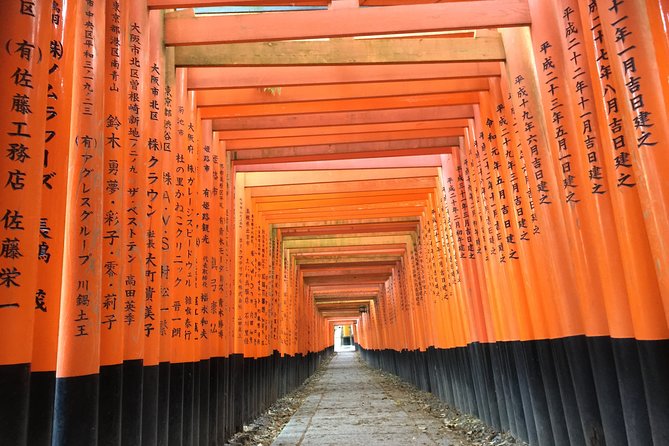
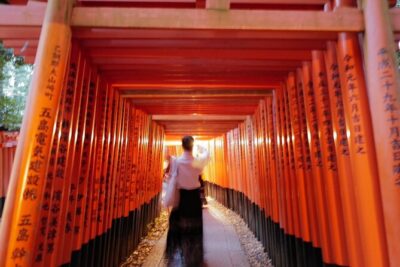
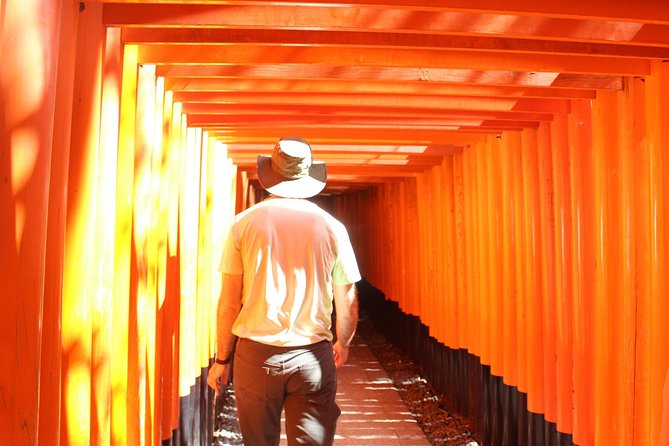
Now you enter Senbon Torii, the famous stretch with 1,000 torii gates. This is the heart of the experience, and the audio route keeps you oriented so you do not just drift in a sea of bright red.
You will be guided through the torii area, with the tour calling out the unmatched vista of the gates. The audio pacing helps you avoid a common trap: rushing forward to take photos, then feeling like you never absorbed what the corridor feels like.
A note on expectations. The torii gates are the star, but they can also be visually repetitive. The audio combats that by directing your attention to specific landmarks and ideas along the way. That keeps the walk interesting, even when you think you might already know what it looks like.
Also, because this section is the most crowded part of the whole shrine, having an audio rhythm is useful. It helps you keep moving in a focused way even when you are boxed in by other people.
Heavy-Light Stone, Okusha, and the root-up pine tree
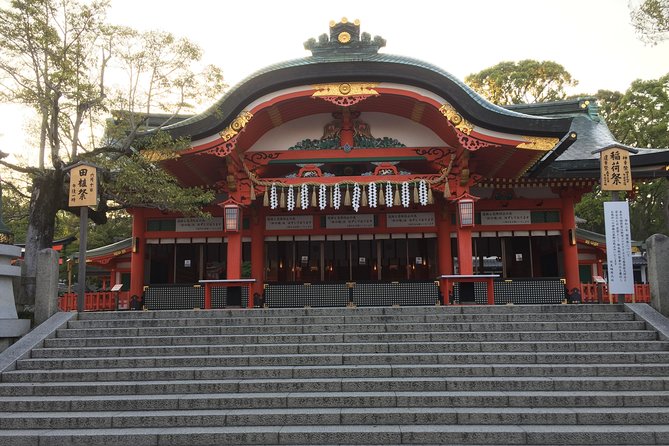
As you keep going, the tour brings in several specific shrine landmarks that help you feel like you explored, not just passed through.
The Heavy-Light Stone wish stop
The overview highlights the Heavy-Light Stone where you can make a wish. This is a great example of a feature that sounds like a gimmick until you actually stand near it, then you realize it is part of why people treat this place like a living spiritual site.
If you want memorable moments that are easy to miss on a standard walk, this is one of the reasons this audio tour is worth it.
Okusha shrine: going farther than the postcard view
Next you learn about the Okusha shrine. The value here is not that it is another building. It is that it signals a deeper layer of the route.
When most people stop early, they miss the feeling of gradually moving into a more secluded part of the complex. Learning about Okusha as you walk helps you understand why the path keeps going.
Root up Pine Tree: a quick stop with meaning
You also make a brief stop by the Root up Pine Tree. A single named tree in a shrine complex tells you you are not just walking a path. You are following a sequence of meaningful points.
This is exactly the sort of place audio helps. If you walked without guidance, you might just treat it like another plant. With the tour explanation, it becomes a story beat.
Ending at Kumataka Shrine: the calm pond finish

The tour ends at Kumataka Shrine, at a lovely pond deep in the shrine’s complex. I like endings like this, especially at a site that can feel loud and busy.
It gives your visit a landing spot. Instead of leaving the gates and immediately being pulled back into crowds outside, you get a final quieter moment before you head back.
The meeting point for the end is listed at Kumataka Shrine, in the Fukakusa Kaidoguchicho area. In the moment, just follow where the app tells you to go until the audio brings you to that pond area.
Practical tips so the tour feels effortless
Here is how to make the experience smooth, based on what actually matters on the ground.
- Download before you arrive. The most common regret with offline tours is realizing you are missing data. Plan to connect to Wi-Fi once you are set up, then start downloading so your audio, maps, and geodata are ready.
- Bring headphones. The tour includes the VoiceMap app, but it does not include headphones.
- Bring a charged phone. You are using your smartphone for audio and navigation support, and you do not want to get stuck with a low battery at the most crowded part of the route.
- Wear shoes you can walk in for under an hour. This is described as an easy stroll, but the torii corridor involves steady walking and lots of footsteps.
- Give yourself time to linger. The tour length is short, but you do not have to “speed-run” it. If you want the gates and the landmarks to land, pause when the audio tells you to stop.
Who this VoiceMap Fushimi Inari tour suits best
This tour is a strong fit if you:
- Like self-guided walking tours and want control of your pace
- Want the story behind what you see, not just a route through famous spots
- Prefer offline reliability over guessing about cell coverage
- Are short on time but still want a focused experience that feels like more than a quick stop
It is also a good option for people who do not want to feel locked into a group schedule. The experience is private in the sense that only your group participates, so you are not joining a large guided pack.
Should you book? My decision guide
Book it if:
- You are visiting Fushimi Inari and want more than gate photos
- You will actually use the offline audio and map support
- You like moving at your own pace through busy places
Skip it if:
- You dislike apps and audio guidance while walking
- You prefer a live guide who can answer questions on the spot
- You are likely to forget downloading ahead of time
If you can handle a smartphone and earbuds, this is great value at $5.99, especially because the access is lifetime and the experience is designed to run in under an hour. Just make sure your phone is ready before you step into the torii flow, and you will get a visit that feels more meaningful than a standard walk through the gates.
FAQ
How much does this Fushimi Inari audio tour cost?
It costs $5.99 per person.
How long is the tour?
The tour takes about 45 minutes to 1 hour.
Is the audio tour in English?
Yes. The tour is available in English, and you get lifetime access.
Does the tour work offline?
Yes. The VoiceMap app provides offline access to audio, maps, and geodata.
Where is the meeting point?
It starts at the fox statue at the entrance to Fushimi Inari Taisha Shrine, opposite Inari station, in Kyoto.
Where does the tour end?
It ends at Kumataka Shrine, at a pond deep in the shrine’s complex.
What do I need to bring?
You need a smartphone and headphones. Food, drink, and transportation are not included.
Is this a group tour with other people?
This is listed as private, meaning only your group participates.
What are the opening hours?
The experience lists opening hours as 12:00 AM to 11:59 PM, Monday through Sunday.
More Walking Tours in Kyoto




New This Season
- Koyasan Day Trip by Private Car from Kyoto
- Old Port Town and Ultimate Sake Tasting Private Tour From Kyoto
- Kyoto’s Timeless Charm: 3hr Exploration of History and Peace
- Kyoto: 5 Types of Sushi Making
- Sacred Peak & Ancient Paths: Kurama-Kibune Hiking Experience
- Kyoto: Exclusive ZEN practice at Manpukuji temple in Uji
- Kyoto: Private Seasonal Aroma Yoga Class
- Traversing Kyoto’s Scenic West – Arashiyama to Kinkakuji
Fushimi Inari Shrine Walks, compared.

Fushimi Inari, Kinkakuji, Bamboo Grove 1 Day Bus Tour
Read our review →
Fushimi Inari Hidden Hiking Tour (Private Option Available)
Read our review →
Kinkakuji,Arashiyama,FushimiInariShrine,NaraPark
Read our review →
Nara, Fushimi Inari Taisha, Arashiyama Bus Tour
Read our review →
Arashiyama, Nara & Fushimi Inari Shrine w/Lunch
Read our review →
Nijo Castle, Kiyomizu & Fushimi Inari Guided Tour
Read our review →
Nijo, Kinkaku-ji, Arashiyama, Kiyomizu & Fushimi Inari
Read our review →