
Reviewed · GION GEISHA QUARTER WALKS
Kyoto: Tea Ceremony with Maiko
One look at a Maiko and everything gets real fast. This 45-minute tea ceremony pairs a Maiko introduction with a hands-on matcha lesson, plus Q and A and up-close photos.
I especially like that you get Kyoto culture without needing hours of setup, and the whole thing stays friendly and easy to join. One thing to note: the venue is not an ochaya, it is in a regular building, and there is no elevator, so you will be using stairs.
In This Review
- Key takeaways before you go
- Kyoto in 45 Minutes, Right by Gojo Station
- What You Really Get When You Sit Down
- Entering the Venue, Stairs Included (No Ochaya Required)
- Maiko Up Close, Without the Stalking Vibe
- The Matcha Lesson and Ohigashi Sweets
- The Q and A Session That Makes It Feel Personal
- Photos, Senjafuda, and the Gifts That Finish Strong
- Maiko or Geiko: Same Format, Different Face
- Price and Value at About $28 per Person
- Who Should Book This Tea Ceremony
- Should You Book? My Quick Decision Guide
- FAQ
- How long is the tea ceremony experience?
- What is the price per person?
- Where do I meet for the activity?
- Is the venue an ochaya or a traditional Japanese house?
- Will I be able to take photos with the Maiko or Geiko?
- What is included in the tea ceremony?
- Is there English translation during the experience?
- Is there an elevator in the building?
- If the host is a Geiko instead of a Maiko, does anything change?
- What should I know about cancellations?
Key takeaways before you go
- 45 minutes that fits Kyoto even if you only have a short stop
- Hands-on matcha making, not just watching
- Ohigashi sweets with the tea, including dried-type Japanese sweets
- Q and A with your host so you learn how daily life works
- Up-close photos plus a Senjafuda lucky charm
Kyoto in 45 Minutes, Right by Gojo Station
If Kyoto has you on a tight schedule, this is exactly the kind of experience that makes the city feel reachable. For a little over half an hour of activity, you get a full rhythm of what people come for in Kyoto: tea etiquette, sweets, and conversation with a traditional performer.
The location is also practical. You meet just a 1-minute walk from Exit 1 of the Karasuma Line Gojo Station. You are close enough that you can tack this onto a morning or afternoon without feeling like you are burning a whole day on logistics.
Now, the value angle. At about $28 per person for a Maiko-led tea ceremony with photos and a lucky charm, you are not just buying a drink. You are paying for guided instruction, a personalized Q and A, and a souvenir moment. In other words, you are paying for time and access, not just for matcha.
What You Really Get When You Sit Down
This is not a long scripted performance. It is structured, yes, but the format is built around you interacting with your host.
Here is the flow you can expect:
- You start with a greeting from the Maiko
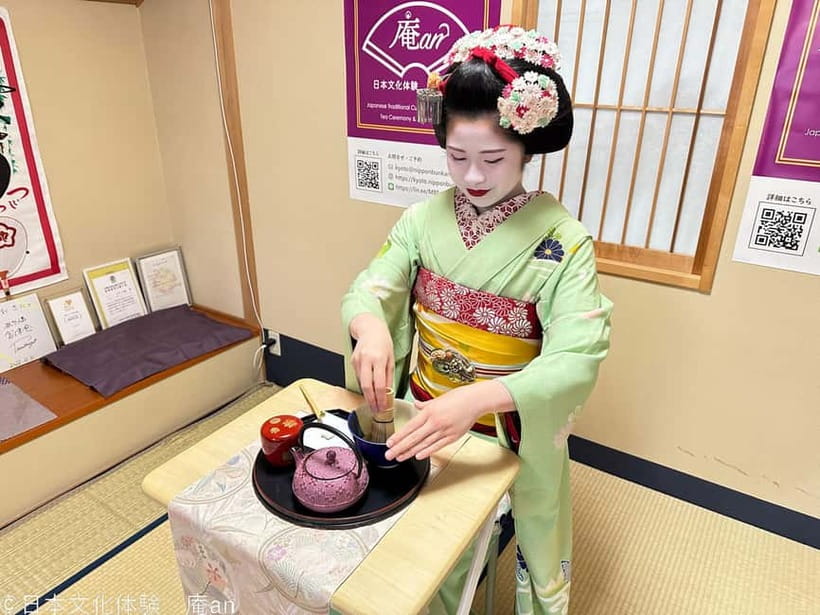
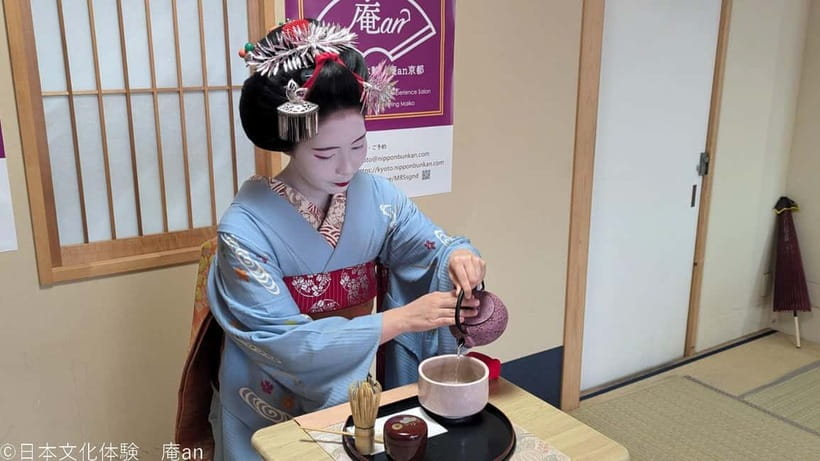
- Then you move into the tea ceremony, including matcha and two dried-type Japanese sweets called Ohigashi
- After the tea part, there is a Q and A session where you can ask questions directly
- By the 30-minute mark, the main ceremony ends
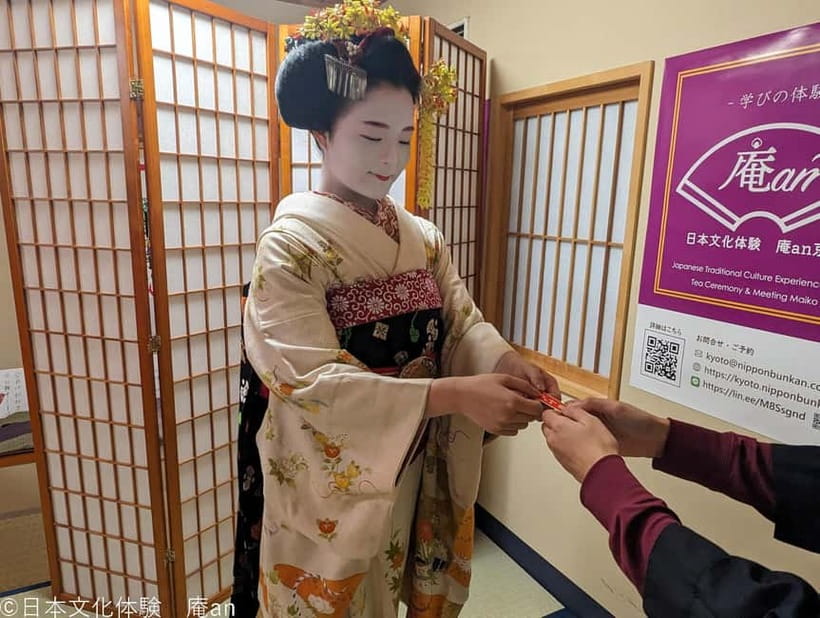
- Then you get the commemorative photo next to the Maiko
- Finally, the Senjafuda charm is presented before the host leaves at 45 minutes
That “ceremony first, talk after” order matters. You taste, learn, and then you can ask better questions because you already understand what you are seeing. Many people get shy early on with cultural experiences, and this setup helps you break that ice.
One more practical detail: depending on the situation, your host might be a Geiko instead of a Maiko. The overall experience stays the same, but the person you meet could change.
More bowls, poured the traditional way
- Kyoto: Tea Ceremony in a Traditional Tea House in Kiyomizu
★ 4.9 · 3,519 reviews - Kyoto: Tea Ceremony Ju-An at Jotokuji Temple
★ 4.9 · 3,207 reviews - Kyoto: 45-Minute Tea Ceremony Lesson Experience
★ 4.3 · 2,378 reviews - Kyoto: Table-Style Tea Ceremony at a Kyo-Machiya
★ 4.9 · 1,211 reviews
Entering the Venue, Stairs Included (No Ochaya Required)
You do not need special outfits, and you do not need to “prepare” like you would for some formal shows. The atmosphere is described as relaxed, and the staff are friendly. That is reassuring if you worry about feeling out of place.
Still, set expectations about the space. This is not presented as an ochaya or a traditional tea house. It is in a building. You should also plan for stairs because there is no elevator to reach the venue.
If you want an easy navigation tip, use the subway exit information carefully. One helpful approach is: get off at metro Exit 1, walk straight ahead and cross a small street, go straight again, then look for the location above the Carnival supermarket and take the stairs up. If you do that, you are unlikely to waste time hunting around.
Maiko Up Close, Without the Stalking Vibe
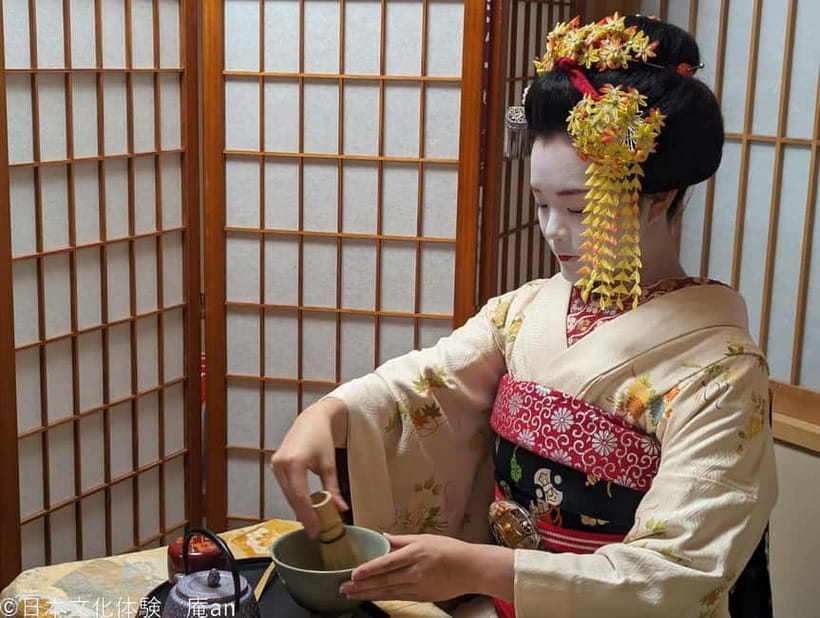
Up-close access is the reason people book this. You are not viewing from a distance. You sit with your host during the ceremony, ask questions, and take a photo right beside her.
The photo part is not an afterthought. It is timed after the main ceremony, so it feels like the “wrap up” moment rather than a rushed checkpoint. And the host gives you a lucky charm called Senjafuda as part of the close.
There is also a big human factor that shows up in the experience: the host is not just performing. You are invited into her world through conversation. In multiple recent sessions, guests highlighted that the Q and A answered questions about daily life and training, and that the host spoke confidently while explaining what is happening.
If English support matters to you, plan on it. The program lists English translation as provided as much as possible, and you can contact them if you want to add it.
The Matcha Lesson and Ohigashi Sweets
This is where the experience becomes practical, not just ceremonial. You learn how to make matcha tea and then you make your own cup. That single step turns watching into doing, and you leave with a skill, not just a photo.
You also get two dried-type Japanese sweets, called Ohigashi. The key point is that you are not trying to figure out what to pair with matcha on your own. The program serves the sweets with the tea, so the tasting has structure.
A hands-on matcha moment is also a smart Kyoto move. Kyoto is full of beautifully made things that you do not always understand until someone explains them. Matcha preparation is one of the easiest ways to get that understanding quickly.
Depending on the session, you might see small extra touches beyond the core tea ritual. For example, at least one recent experience noted sake being poured during the ceremony. I would treat that as possible, not guaranteed, but it does suggest that the host may add small Kyoto-style hospitality moments.
The Q and A Session That Makes It Feel Personal
The Q and A is one of the most praised parts of the whole program. This is not a lecture where you watch and hope you get one question in. It is built as a highlight, with time set aside for you to talk directly with your host.
This is also where you learn the difference between “what you see” and “what it means.” Tea culture has visible steps, but it also has etiquette, timing, and lifestyle. When you ask about daily life, training, or what it takes to become Geiko, the answers help you connect the performance to the person behind it.
If you like getting more out of cultural moments, come with 2 to 4 simple questions. Things like:
- How does the daily routine look?
- What is the hardest part to learn at first?
- What does tea etiquette mean in everyday terms?
- What should guests notice when they watch a tea ceremony?
Even if your question is basic, asking it is the point. The format is set up for you to learn.
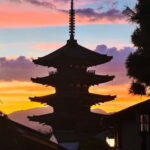
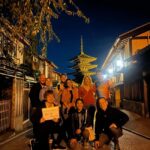
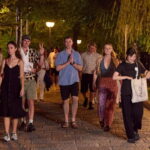
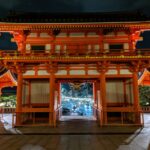
Lantern-lit streets of the geisha quarter
Photos, Senjafuda, and the Gifts That Finish Strong
The final third is built to make you leave with something tangible and memorable.
First, you get the commemorative photo beside the Maiko. This matters because it creates a clear memory anchor. It also helps you feel like you truly participated, not just observed.
Then you receive the Senjafuda lucky charm. That charm is more than a souvenir label. In a city where you can buy matcha kits and ceramics everywhere, a small personal charm tied to the event feels special. It also gives you a reason to look back later and remember the actual experience, not just the location.
Maiko or Geiko: Same Format, Different Face
Kyoto visitors often picture the classic Maiko moment, and this program delivers that possibility. But the details are worth understanding up front.
Depending on the event date and situation, the experience may be hosted by either a Maiko or a Geiko. So you might arrive expecting one, and get the other. The program description is clear about this, and it is part of why it remains flexible.
Practically, this means your main “output” is the format: matcha making, Ohigashi, Q and A, photo time, and Senjafuda. The person you meet changes, but the cultural learning structure stays in place.
If you are booking specifically to meet a Maiko, still go in with an open mind. Kyoto tradition is connected across roles. You are still getting the access that makes this worth it.
Price and Value at About $28 per Person
Let’s talk value in plain terms.
For roughly $28 per person and a 45-minute duration, you get:
- Tea ceremony time led by your host
- Matcha instruction and hands-on making
- Two dried-type Ohigashi sweets
- Q and A time
- Up-close photo opportunity
- Senjafuda lucky charm
That bundle is the value. Many “cultural” tickets are basically show seating. This is more like a short guided workshop plus conversation plus photo access.
Could it feel short? Sure, 45 minutes is not a full evening. But for many Kyoto itineraries, short is the best strategy. You get a high-impact moment with minimal time cost, and you can spend your remaining hours exploring neighborhoods and food.
The best use case is when Kyoto is sandwiched between train connections or another activity and you want something meaningful that does not require a long commitment.
Who Should Book This Tea Ceremony
This fits best if you want:
- A fast, Kyoto-flavored activity near major transit
- A hands-on cultural skill (matcha making)
- Up-close interaction and a chance to ask questions
- A souvenir moment that is tied to the event
It also works well for couples and solo travelers. The program is short, structured, and easy to slot into the day.
If you prefer quiet museums and low interaction, you might find the conversation-heavy format more social than you want. But if you like meeting people and asking questions, this will feel like the right kind of respectful closeness.
One more note: the program does not mention kids-friendly seating rules beyond payment. Children who require their own seat pay the same fee. Children who sit on a parent’s lap are free of charge if they are under 2 years old.
Should You Book? My Quick Decision Guide
Book this if you want Kyoto culture in a tight window and you like learning by doing. The mix of matcha making, Q and A, photos, and the Senjafuda charm is a strong package for the time and cost.
Skip it if you hate stairs, dislike interactive formats, or you need a long, wandering cultural experience. Also, if you expect a traditional ochaya setting, this is not marketed as one, even though the atmosphere is described as relaxed.
If you are in Kyoto with a busy itinerary, this is one of those “small time investment, big memory” experiences. It is practical, politely structured, and focused on the human side of Kyoto tradition.
FAQ
How long is the tea ceremony experience?
The experience lasts about 45 minutes.
What is the price per person?
The price is listed as $28 per person.
Where do I meet for the activity?
You meet at a point that is a 1-minute walk from Exit 1 of the Subway Karasuma Line Gojo Station. The store entrance faces Gojo-dori.
Is the venue an ochaya or a traditional Japanese house?
No. The venue is located in a building and is not described as an ochaya or traditional house, though it is said to have a relaxed atmosphere.
Will I be able to take photos with the Maiko or Geiko?
Yes. There is a photo opportunity where you take a commemorative photo right beside the host.
What is included in the tea ceremony?
It includes tea ceremony with the host, matcha, two dried-type Japanese sweets called Ohigashi, the photo opportunity, and a Senjafuda lucky charm gift.
Is there English translation during the experience?
English translation is provided as much as possible. If you would like to add it, you should contact the provider.
Is there an elevator in the building?
No. There is no elevator, and you will need to use stairs.
If the host is a Geiko instead of a Maiko, does anything change?
The program notes that depending on the situation, it may be hosted by a Maiko or a Geiko. The overall activity format still includes the tea ceremony, Q and A, photo time, and the Senjafuda gift.
What should I know about cancellations?
Free cancellation is available up to 8 days in advance for a full refund. The policy also notes that delays and latecomers are not entitled to a refund, and a cancellation fee may apply regardless of the reason.
New This Season
- Koyasan Day Trip by Private Car from Kyoto
- Old Port Town and Ultimate Sake Tasting Private Tour From Kyoto
- Kyoto’s Timeless Charm: 3hr Exploration of History and Peace
- Kyoto: 5 Types of Sushi Making
- Sacred Peak & Ancient Paths: Kurama-Kibune Hiking Experience
- Kyoto: Exclusive ZEN practice at Manpukuji temple in Uji
- Kyoto: Private Seasonal Aroma Yoga Class
- Traversing Kyoto’s Scenic West – Arashiyama to Kinkakuji
Gion Geisha Quarter Walks, compared.
Kyoto Geisha Walking Tour: Gion District & Hidden Gems
Read our review →
Gion Magical Night Walking Tour with Geisha Trivia
Read our review →
Gion Geisha District Walking Tour – Stories of Geisha
Read our review →
Best of Kyoto: Gion, Geisha, Pagodas & Cobblestones
Read our review →
Kyoto Night Foodie Tour in Gion (9+ dishes + 6 Sake tastings)
Read our review →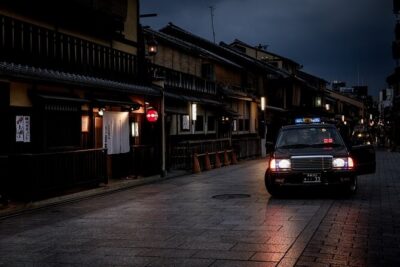
Kyoto Gion Geisha District Walking Tour – The Stories of Geisha
Read our review →
Kyoto Gion: 2-Hour Geisha Culture & History Walking Tour
Read our review →Also filed under